Green Aventurine: Meaning, Benefits & Properties (2026 Guide)
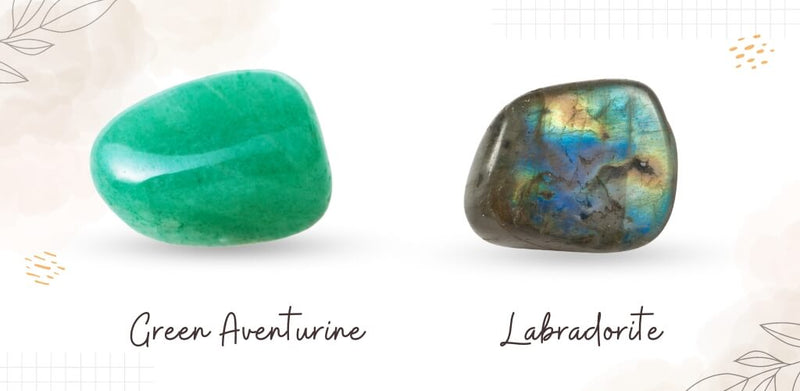
Green aventurine is the soft-green "stone of opportunity." Mineralogically, it's a form of quartzite — a metamorphic rock built mostly of compacted quartz — coloured by suspended flakes of fuchsite, a chromium-rich variety of muscovite mica that gives the stone its bright green hue and characteristic silvery shimmer (Wikipedia). Its hardness sits at around 6.5 on the Mohs scale and its specific gravity at 2.64 to 2.69. The name comes from a small accident in an 18th-century Italian glass factory, which is one of the more charming etymologies in mineralogy. In crystal-healing tradition, green aventurine is the heart-chakra opportunity stone people reach for when they want to attract luck, soften emotional reactivity, or open themselves to new beginnings. This guide covers the verified mineralogy, the surprising glass-to-mineral name story, and the right way to care for the stone.
- Green aventurine is a quartzite (SiO₂-dominant) at Mohs 6.5 with specific gravity 2.64 to 2.69 (Wikipedia).
- The green colour and silvery shimmer (called aventurescence) come from fuchsite, a chromium-bearing muscovite mica suspended through the rock.
- The name comes from Italian "a ventura" (by chance), originally describing a sparkly glass discovered in 18th-century Murano. Mineralogists later applied it to the stone because the appearance was similar.
- Crystal-healing use: heart chakra (Anahata), the "stone of opportunity" tied to luck, optimism, and emotional balance.
- Major source: India (Mysore and Chennai regions) for green and blue-green material; Russia, Spain, and Chile for cream, grey, and orange varieties (Wikipedia).
- Care: durable enough at Mohs 6.5 for daily-wear bracelets and pendants. Avoid ultrasonic cleaners.

What Is Green Aventurine?
Green aventurine is a form of quartzite, a metamorphic rock primarily composed of quartz (SiO₂), with a Mohs hardness of around 6.5 and a specific gravity of 2.64 to 2.69 (Wikipedia). Its hardness is somewhat lower than crystalline quartz at Mohs 7 because the rock is built from compacted granular quartz rather than a single continuous crystal. The trade-off is that the granular structure creates room for inclusions of other minerals, and that's where the colour story begins.
The classic green hue and silvery shimmer come from fuchsite, a chromium-bearing variety of muscovite mica suspended through the quartzite as small reflective flakes (Wikipedia). Catch the stone in good light and rotate it slowly — the surface seems to twinkle as the fuchsite flakes catch the light at slightly different angles. The optical effect has its own name: aventurescence.
In crystal-healing tradition, green aventurine is the "stone of opportunity," the default crystal for luck, optimism, and the kind of soft, receptive openness that helps when you're trying to attract something new. The customers I see returning for second pieces are almost always people in the early phases of a new chapter: launching a business, starting to date again after a hard year, or quietly working on something they haven't told anyone about yet.
Why Is It Called Aventurine?
The name has one of the better origin stories in mineralogy. "Aventurine" comes from the Italian phrase a ventura, meaning "by chance" (Wikipedia), and the phrase was first applied not to a stone but to a glass. Sometime in the 18th century, glassmakers on the Venetian island of Murano accidentally dropped copper filings into a batch of molten glass. When the glass cooled, the suspended copper flakes caught the light and produced a sparkling effect nobody had managed to make on purpose. The Murano glassmakers called it vetro a ventura, "glass by chance," and the name stuck.
The mineral was named after the glass, not the other way around. When 19th-century mineralogists began studying green quartzite that contained shimmering fuchsite flakes, they noticed the appearance was strikingly similar to the Italian glass and applied the same name. Today the optical phenomenon itself is called aventurescence in honour of the original discovery, and any sparkling-flake effect in a translucent host material can earn the descriptor.
The story is worth knowing because it inverts the usual mineralogical-naming convention. Most stones are named for places (turquoise, andalusite), people (howlite, sillimanite), or visual features (rose quartz, smoky quartz). Aventurine is one of the rare cases where a manufactured material gave its name to a natural mineral, and the linguistic borrow happened the "wrong" way around.
Where Does Green Aventurine Come From?
The majority of green and blue-green aventurine on the global market originates in India, particularly in the regions around Mysore and Chennai (Wikipedia). Indian aventurine has been the dominant commercial source for over a century, with the Mysore mining region alone producing the bulk of the tumbled stones, beads, and carved pieces sold worldwide. Cream, grey, and orange aventurine is mined in Russia, Spain, and Chile, with smaller quantities of various colours produced in Brazil, Tanzania, and Tibet.
The geological context is consistent across these locations. Aventurine forms when quartz-rich sedimentary or igneous rock is metamorphosed by heat and pressure, with the green colour appearing when chromium-bearing fuchsite mica is present in the original mineral assemblage. The process compacts the quartz into the granular metamorphic structure that gives aventurine its slightly softer Mohs reading and the room for the mica flakes that produce its shimmer.
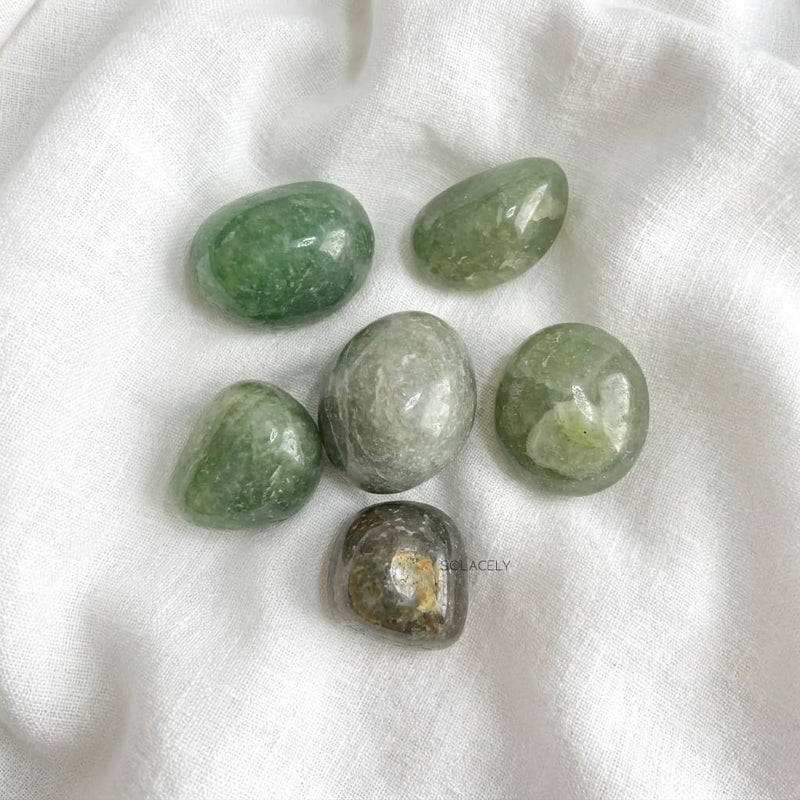
Most aventurine in our showroom comes through Indian wholesale channels, which is the same supply chain most North American and European crystal shops rely on. The aesthetic is fairly consistent across the Indian deposits — a soft sage to medium forest green, with a satin sheen that flares brighter as the stone is rotated.
What Are the Benefits and Healing Properties of Green Aventurine?
Crystal-healing tradition assigns green aventurine three layers of benefit: emotional (optimism, opportunity, soft openness), physical (energetic support tied to the heart and circulation, traditional only), and metaphysical (heart-chakra balance, attracting luck, gentle manifestation). None of these claims is medically validated. They reflect long-standing tradition rather than clinical research.
Emotional Healing Properties
Green aventurine is the optimism stone. The traditional indications cluster around openness rather than intensity: softening reactivity after a frustrating week, easing the tightness that comes from holding emotional armour too long, and gently encouraging the kind of mood that notices opportunities rather than missing them. Practitioners pair it with rose quartz when emotional softness is the focus, and with citrine when the goal is forward propulsion.
The most common phrase I've heard from customers about green aventurine is some version of "I needed a reset." It's a relatively gentle stone in the modern crystal lexicon — nothing dramatic, nothing high-intensity. A deliberate quiet.
Physical Healing Properties (Traditional)
In the crystal-healing tradition, green aventurine is associated with the heart and circulatory system, partly through its heart-chakra link and partly through the colour symbolism of soft green tissue. Practitioners place it over the chest during energy work, sometimes pairing it with rose quartz for what's traditionally called "open heart" support.
None of this is medical treatment. Green aventurine hasn't been shown in any peer-reviewed study to influence blood pressure, circulation, immunity, or any biological process. The "physical" tradition is best read as a metaphor for attention rather than a treatment claim.
Metaphysical & "Stone of Opportunity" Properties
Metaphysically, green aventurine is the default opportunity-and-luck stone of the modern crystal tradition. The reading is intuitive: green is the colour of new growth, fuchsite-shimmer suggests possibility catching the light, and the heart-chakra association links luck to receptiveness. Practitioners carry green aventurine to job interviews, performance auditions, lottery purchases, and first dates — anywhere the situation involves an outcome someone hopes will lean their way.
Practitioners often pair green aventurine with citrine for "wealth and opportunity" grids, with clear quartz to amplify intention, and with rose quartz when love-and-luck overlap. Used alone, it's most often programmed as a daily companion — a small steady current of optimistic attention rather than a single-use ritual stone.
Which Chakra Is Green Aventurine For?
Green aventurine is most strongly associated with the heart chakra (Anahata), the energy centre at the centre of the chest traditionally linked to love, compassion, opportunity, and emotional balance. The pairing is intuitive. The heart chakra's primary colour in modern chakra theory is green, and green aventurine is one of the cleanest, most accessible green stones in the modern wellness market.
Some practitioners use green aventurine secondarily on the higher heart or thymus chakra (a position between the heart and throat in extended chakra systems) for empathy work, and a few traditions place it on the solar plexus when the focus is opportunity-as-confidence rather than opportunity-as-receptiveness. Its primary home is heart, and most modern crystal-healing protocols keep it there.
A simple way to use this: lie down, place a small green aventurine tumble at the centre of the chest, and breathe slowly for five to ten minutes with one specific intention around something you're trying to attract or receive. Soft, specific, repeatable.
How Can You Use Green Aventurine Day-to-Day?
The three most common uses are jewelry, meditation, and workspace placement. Each has a slightly different goal, and the form of green aventurine you choose should match it. Tumbled stones are versatile for meditation. Beaded bracelets are the most common jewelry form. Larger raw chunks and palmstones sit comfortably on a desk or by a notebook during planning sessions.
Wearing Green Aventurine Jewelry
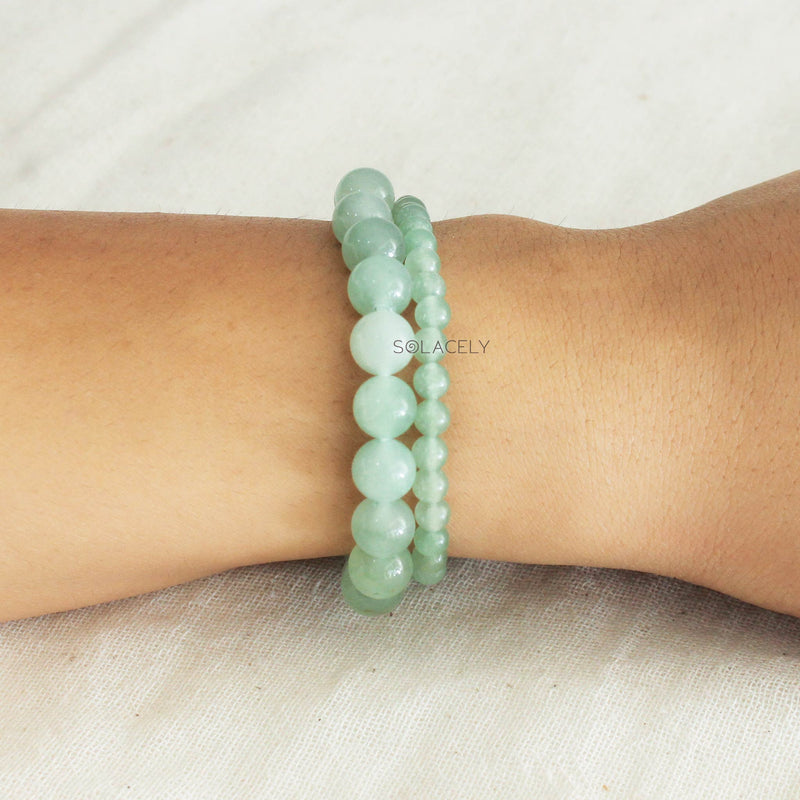
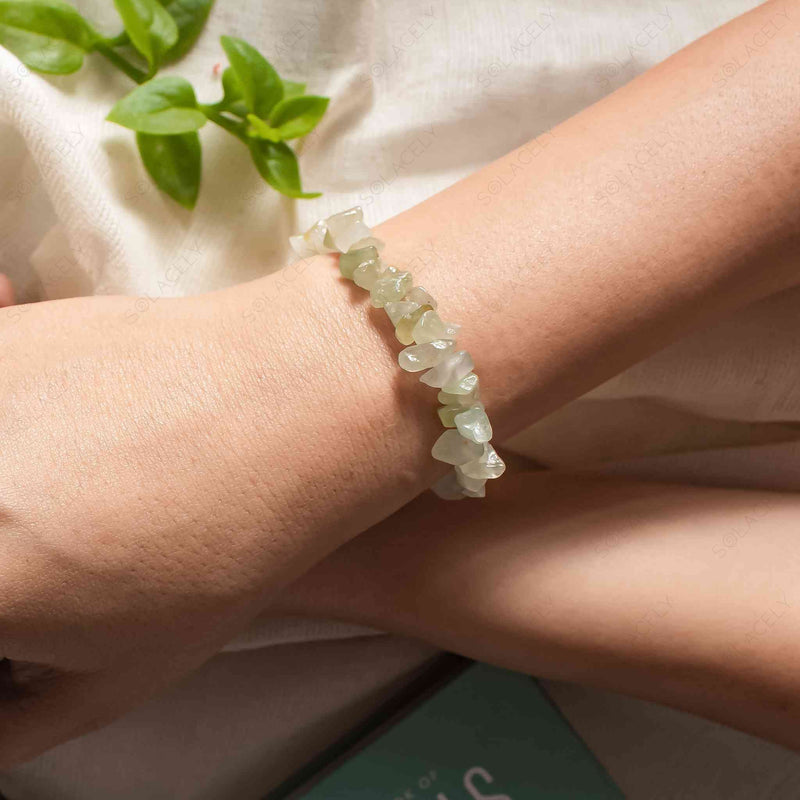
Green aventurine jewelry is one of the easier crystal-jewelry entry points because the stone at Mohs 6.5 wears well in daily use. Beaded bracelets are the most common form, especially in stacked sets paired with rose quartz, citrine, and clear quartz. Polished cabochons set in silver pendants are popular as a more understated option.
For ring settings, green aventurine works best in occasional-wear pieces rather than daily-wear bands worn through manual work. The granular metamorphic structure can chip under hard direct impact even though the stone is generally durable.
Green Aventurine for Meditation
For meditation, hold a tumbled green aventurine in your dominant hand and close the other around it, or place a polished palmstone over the centre of the chest lying down. The stone has a noticeable but moderate physical weight, and the matte-soft surface tends to feel "calming" rather than activating in the hand.
A specific green aventurine meditation for opportunity: three rounds of slow breathing, one stated intention focused on something you'd like to attract (a meeting that goes well, a connection that opens, an outcome you're hoping for), three more rounds, then put the stone back. Five minutes total. The point is openness, not effort.
Green Aventurine at the Workspace
Green aventurine is one of the most-recommended workspace stones for new ventures and creative work. A small tumble kept beside a notebook, a polished palmstone on the corner of a desk, or a green aventurine cluster near financial paperwork all work the same way: a visible cue tied to a specific opportunity intention.
In feng shui terms, green aventurine is most often placed in the wealth corner (back-left from the front door of the room) or near the place where new-project planning physically happens. A piece you reset weekly with a stated intention will feel more "active" than one that drifts into the role of decorative paperweight.
How Do You Cleanse and Charge Green Aventurine?
Green aventurine at Mohs 6.5 is durable enough that physical cleaning is straightforward: warm soapy water with a soft cloth handles tumbled stones and most jewelry. Skip ultrasonic cleaners and steam (sudden temperature shifts can damage any quartzite). For energetic cleansing, dry methods are gentlest, and brief direct sunlight is acceptable for charging since green aventurine doesn't fade in normal sun exposure.
Why Cleanse and Charge Green Aventurine?
In crystal-healing practice, cleansing clears residual energy a stone has picked up from its environment or wearer. Even if you don't subscribe to the energetic side, regular cleansing is good physical hygiene for jewelry: skin oils, dust, and lotion residue dull the stone's natural shimmer over time, and removing them keeps the aventurescence crisp.
A reasonable cadence: cleanse green aventurine once a month with normal use, more often if you're using it during a specific opportunity intention or wearing a piece daily through workouts. Charging is a separate step (re-energising the stone toward an intention), traditionally done after cleansing.
How to Cleanse Green Aventurine (4 Safe Methods)
- Sound. Hold the stone near a singing bowl or tuning fork for 30 to 60 seconds. The safest method for jewelry — no impact, no surface stress.
- Smoke. Pass the stone through sage, palo santo, or incense smoke for about a minute. Don't hold it in direct flame.
- Moonlight. Set the stone on a windowsill overnight, ideally on a full or new moon. Bring it back inside before morning.
- Selenite or clear quartz contact. Rest green aventurine on a selenite plate or beside a clear quartz cluster for 6 to 12 hours.
Skip ultrasonic cleaners and steam. Both can stress the granular metamorphic structure of any quartzite.
How to Charge Green Aventurine (4 Methods)
- Brief sunlight. Place green aventurine in indirect or short direct sunlight (15 to 30 minutes max). Solar charging matches its growth-and-opportunity associations beautifully.
- Intention setting. Hold the cleansed stone, state one specific opportunity intention out loud, and breathe with it for two to three minutes. Specific beats vague every time with green aventurine.
- Crystal grid. Place green aventurine at the centre of a grid surrounded by clear quartz points and small citrine tumbles to amplify a luck or opportunity intention. Leave for 24 hours.
- Pocket carry. Carry the stone in a pocket through a deliberately opportunity-focused day (an interview, a launch, a pitch), then place it back on its altar. The stone takes on the energy of the practice.
Frequently Asked Questions
What is green aventurine?
Green aventurine is a form of quartzite, a metamorphic rock primarily composed of quartz (SiO₂), with a Mohs hardness of around 6.5 and a specific gravity of 2.64 to 2.69 (Wikipedia). Its green colour and characteristic shimmer come from inclusions of fuchsite, a chromium-rich variety of muscovite mica.
What gives green aventurine its colour?
The classic green colour comes from fuchsite, a chromium-bearing variety of muscovite mica suspended through the quartzite (Wikipedia). The flake-like fuchsite inclusions also produce the characteristic silvery shimmer called aventurescence, the optical effect that gives the entire mineral family its name.
Why is it called aventurine?
The name comes from the Italian phrase "a ventura," meaning "by chance" (Wikipedia). The word originally referred to a sparkly glass accidentally created by Murano glassmakers in the 18th century. Mineralogists later applied the name to the green quartzite mineral because its silvery shimmer resembled the glass.
Which chakra is green aventurine for?
Green aventurine is most strongly associated with the heart chakra (Anahata), the energy centre at the centre of the chest traditionally linked to love, compassion, opportunity, and emotional balance. The bright green colour matches the heart chakra's primary colour symbolism in modern crystal-healing practice.
Where does green aventurine come from?
The majority of green aventurine on the global market originates in India, particularly in the regions around Mysore and Chennai (Wikipedia). Russia, Spain, and Chile also produce aventurine in cream, grey, and orange colours, with smaller quantities mined in Brazil, Tanzania, and Tibet.
Can green aventurine get wet?
Yes. At Mohs 6.5, green aventurine is durable enough for warm soapy water cleaning with a soft cloth. Skip ultrasonic cleaners and steam (sudden temperature changes can stress any quartz-family stone). For energetic cleansing, sound, smoke, moonlight, and selenite contact are the gentlest options.
Is green aventurine safe for daily wear?
Yes, with normal care. At Mohs 6.5 it's slightly softer than crystalline quartz at 7, but durable enough for bracelets, pendants, and earrings in everyday use. For ring settings exposed to harder daily knocks, occasional-wear pieces hold up better than statement rings worn through manual work.