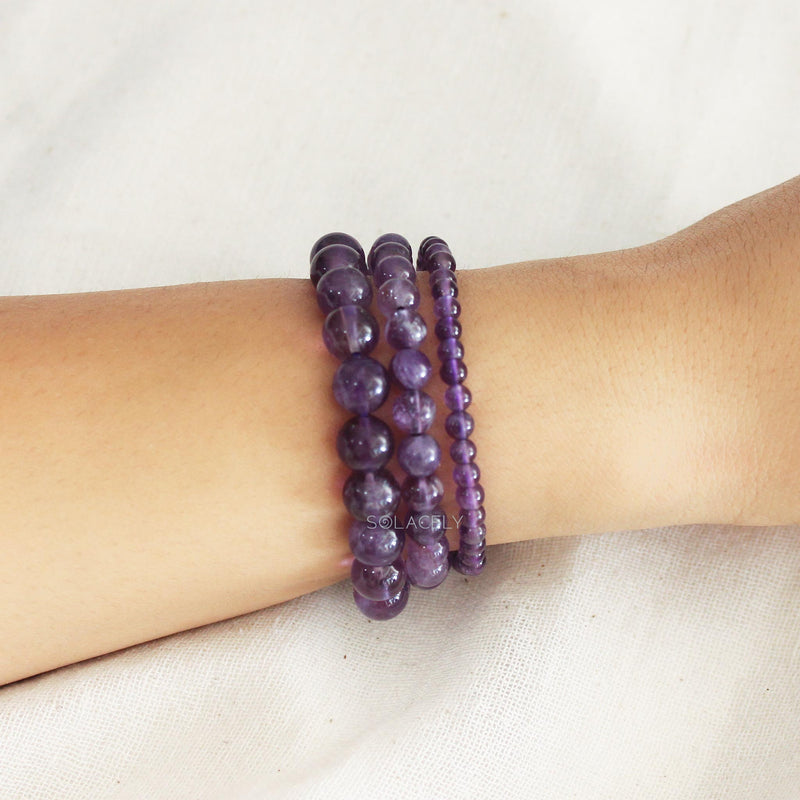
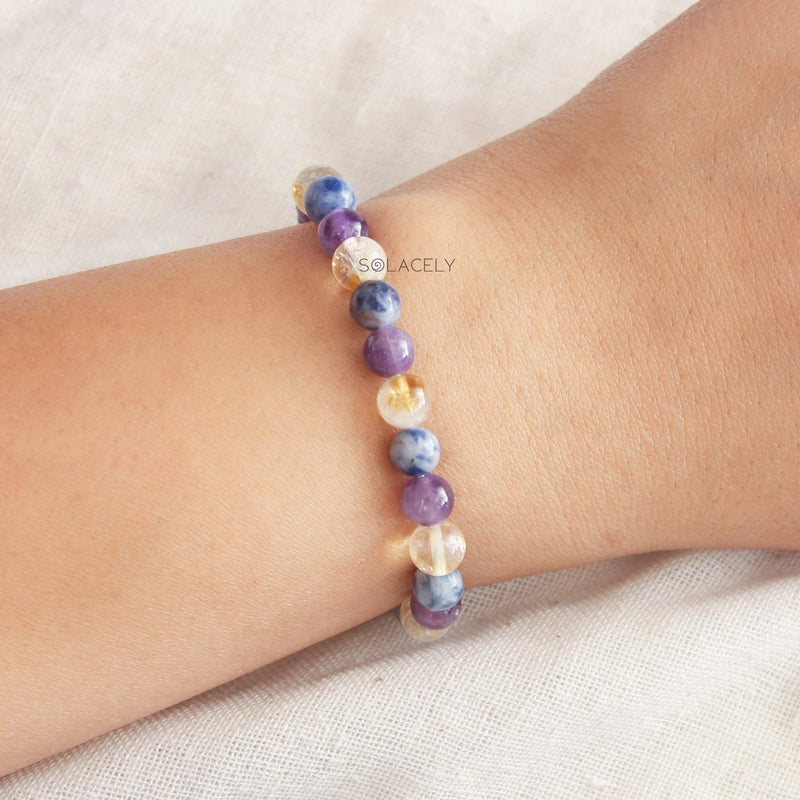
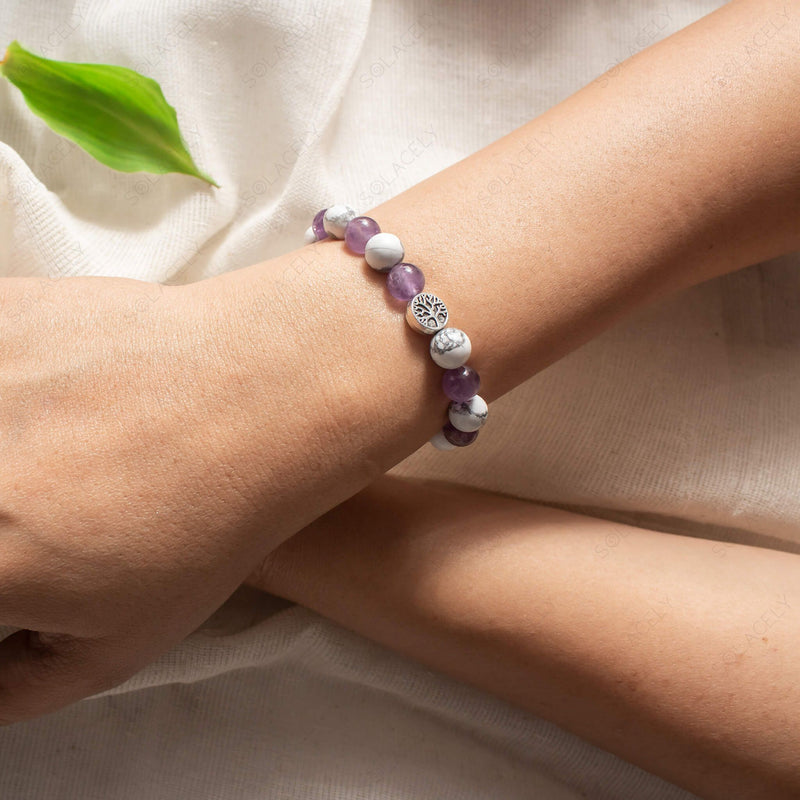
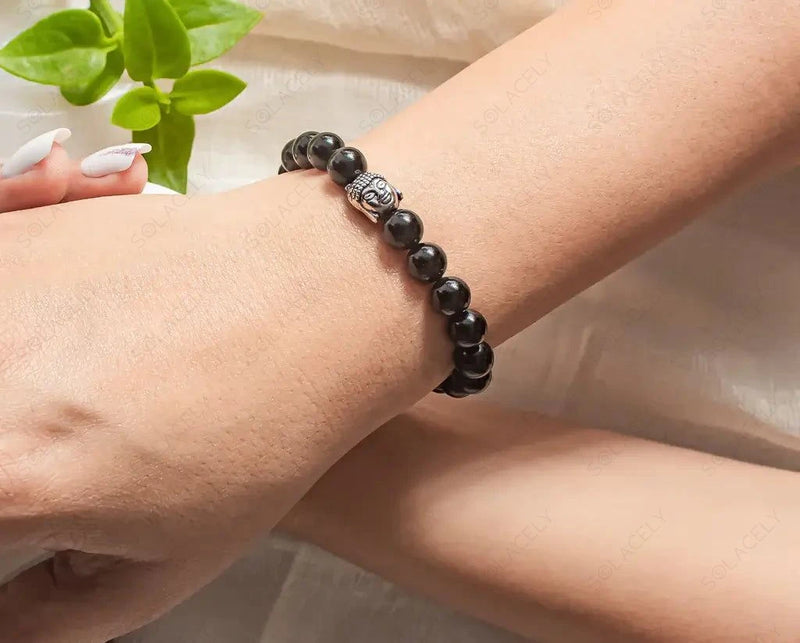
People reach for amethyst, lepidolite, blue lace agate and howlite during an anxious stretch, usually as a bracelet worn all day or a smooth tumble carried in a pocket. Rose quartz, black tourmaline, smoky quartz and sodalite complete the group. Each one is kept as a daily cue for the calm you have chosen to practise.
Key takeaways
- Eight stones make up the usual calm kit: amethyst, lepidolite, blue lace agate, howlite, rose quartz, black tourmaline, smoky quartz and sodalite.
- Anxiety is treatable. A doctor or a mental health professional is the route that treats it, and a stone is kept as company alongside that care.
- Amethyst, rose quartz and smoky quartz are quartz varieties at 7 on the Mohs scale, which is why they hold up as everyday bracelet beads.
- Lepidolite sits at 2.5 to 3 and howlite at 3.5, so both are soft, porous and best kept dry.
- The commonest way to use one is to hold it in your palm and let the out-breath run longer than the in-breath for a minute or two.
- Amethyst and rose quartz can pale after long spells in strong sunlight, so a sunny windowsill is the wrong place to keep them.
Which crystals are traditionally kept for anxiety and stress?
Eight stones do most of the work: amethyst, lepidolite, blue lace agate, howlite, rose quartz, black tourmaline, smoky quartz and sodalite. Some are pale and gentle in colour, others dark and steadying. Most people settle on two or three of them rather than collecting the whole set.
Anxiety is treatable, and treatable is the word that matters. A doctor or a mental health professional is the route that treats it, through talking therapy, medication or both, and most people improve with the right support. A stone travels alongside that care as company, something to hold on the way there.
| Stone | Mohs | Traditionally kept for | Usually kept as |
|---|---|---|---|
| Amethyst | 7 | Calm, settled evenings | Bedside cluster, bracelet |
| Lepidolite | 2.5 to 3 | Quiet, easing worry | Palm stone, pouch |
| Blue lace agate | 6.5 to 7 | Gentle speech, softness | Bracelet, pendant |
| Howlite | 3.5 | Stillness, a quieter mind | Bedside tumble |
| Rose quartz | 7 | Warmth, self-kindness | Pocket tumble, bracelet |
| Black tourmaline | 7 to 7.5 | Protection, steadiness | Pocket stone, hallway piece |
| Smoky quartz | 7 | Grounding, letting things settle | Palm stone, desk piece |
| Sodalite | 5.5 to 6 | Clear thinking, calm words | Desk piece, bracelet |
Amethyst is the one most people meet first. It is the purple variety of quartz, coloured by traces of iron, and it has been the calm stone of any collection for centuries. Our full guide to amethyst covers its colour range and where it is mined.
Two of the eight sit at the soft end of the scale. Lepidolite is a lithium-bearing mica, which is why it splits into silky flaky layers and rates only 2.5 to 3 for hardness. Howlite is a white borate mineral veined in grey, at 3.5. Blue lace agate is far tougher, a banded chalcedony ribboned in pale blue and white at 6.5 to 7. All three are traditionally kept close during unsettled weeks.
How do people actually use these crystals?
Three habits cover almost all of it: holding a stone while you lengthen the exhale, keeping one on the bedside table, and wearing a bracelet as a private reminder through the day. None of them takes any training, and the simplest version is the one people actually keep up.
Hold one and lengthen the exhale
Sit down, put the stone in your palm and close your fingers round it. Breathe in for a count of four, then let the out-breath run to six or eight. Two minutes is plenty. The weight and the cool surface give your attention something plain to rest on while the breath slows, and the stone keeps the intention you set when you picked it up in view. Smoky quartz and howlite suit this best, since both are widely sold as flat palm stones.
Keep one by the bed
A tumble or a small cluster on the bedside table is the most common placement of all. Amethyst has long been the bedroom stone, and people keep it there as a marker for winding down. Set it within arm's reach rather than across the room, so that if you wake at three in the morning there is something to hold. Our notes on crystals for sleep go further into bedroom placement.
Wear a bracelet as a private reminder
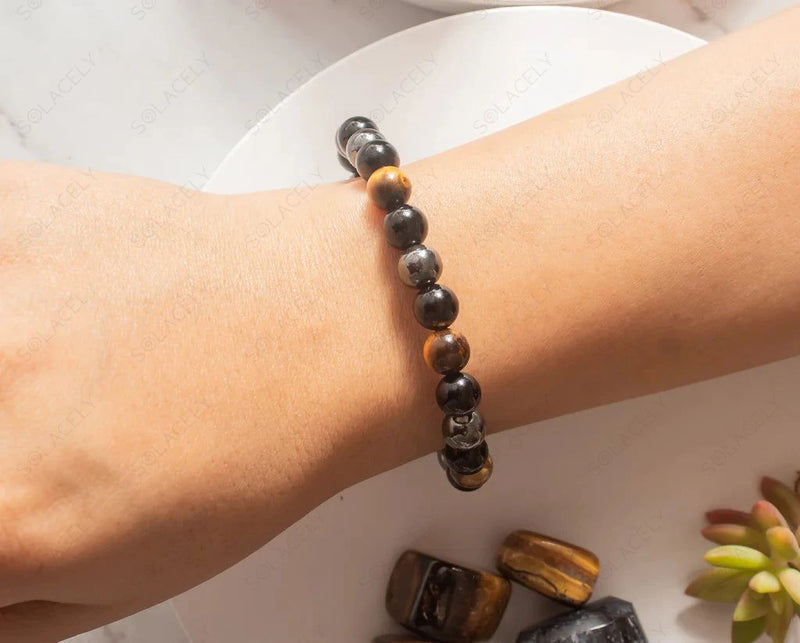
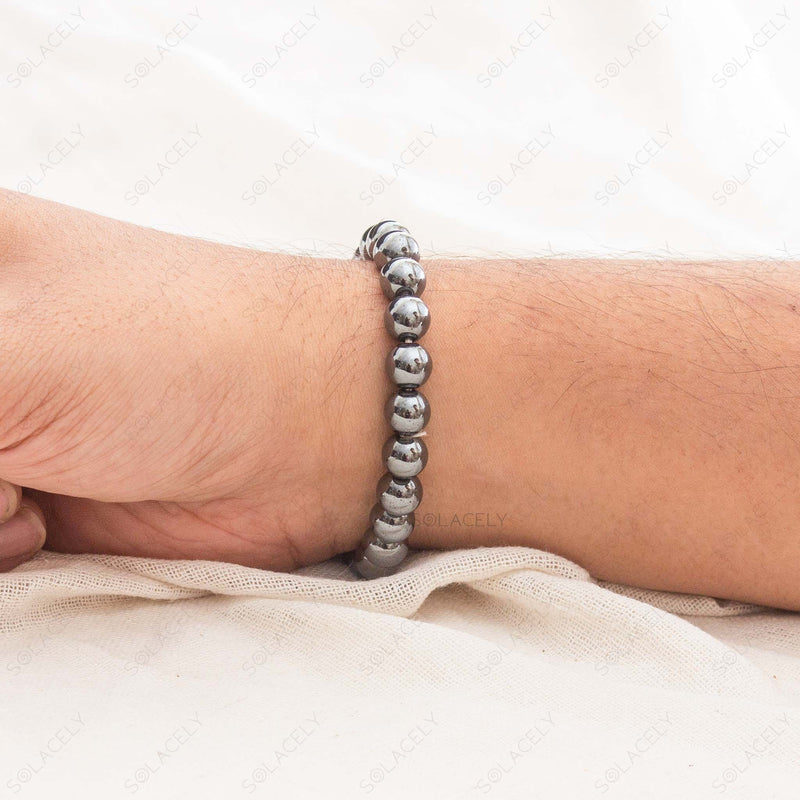
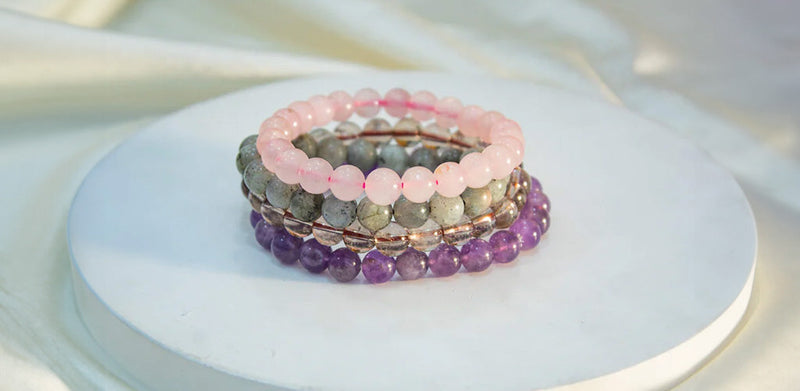
A bracelet does something a shelf piece cannot. It comes with you. In a meeting, on a crowded platform or in a waiting room, turning the beads once round your wrist is a quiet signal to yourself that nobody else notices. Amethyst, lepidolite, rose quartz and blue lace agate all string well at 8mm, and a mixed strand carries more than one intention on the same cord.
Carry a tumble in your pocket
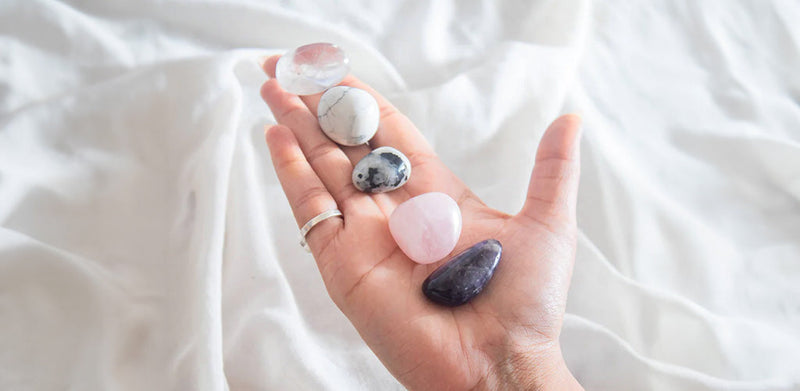
Pocket tumbles are for the days you are out and about. Reaching in and finding the stone is a small anchor, especially before something you have been dreading. Rose quartz and black tourmaline are the two most often carried this way, one for warmth and one for steadiness. Our piece on crystals for overthinking looks at the same habit for a busy head.
When is it worth speaking to someone?
It is worth speaking to your GP or a mental health professional when worry has stuck around for weeks, when panic attacks arrive, when you find yourself avoiding things you used to do, or when sleep and appetite have shifted. These are exactly the situations that professional support is built for.
- Worry or tension that has run on for several weeks and is not lifting
- Panic attacks, or a growing fear of having one
- Avoiding places, people or tasks, so that daily life keeps getting smaller
- Broken sleep, early waking, or a clear change in appetite
- Physical signs such as a racing heart, tight chest or constant restlessness
The National Institute of Mental Health describes anxiety disorders as among the most common conditions there are, and as highly treatable, with talking therapies and medication as the main routes. Making that appointment is worth doing sooner rather than later. Bring the stone with you if it helps you sit in the waiting room.
If you are already under someone's care, keep going with what has been arranged for you, and talk to that clinician before you change anything about it. If you or someone you know is in immediate danger or at risk of harm, contact your local emergency services straight away, or go to the nearest emergency department.
Where is the best place to keep each stone?
The bedside table, the desk and your pocket cover most of it. Put a stone where the difficult moments actually happen rather than where it looks best. A tumble that lives in a drawer is easy to forget. One sitting by the keyboard is there at four in the afternoon on a hard day.
In the bedroom, amethyst is the traditional choice, kept on the nightstand or tucked into a small pouch under the pillow. Howlite is the other regular, a plain white stone set within arm's reach for the small hours. Keep the bedroom collection to one or two pieces. A crowded nightstand works against the whole point of it.
At a desk, sodalite and smoky quartz are the usual pair, one long associated with clear thinking and measured words, the other with grounding and letting things settle. Set them where your hand falls naturally, beside the keyboard rather than behind the monitor. Between calls, picking one up for thirty seconds is often the only pause on offer.
For bags and pockets, black tourmaline and rose quartz travel best. Tourmaline goes in the outer pocket for commutes, appointments and crowded places. Rose quartz goes in the one you reach into without thinking. If you would rather wear than carry, our guide to crystals for anxiety and panic attacks covers bracelet options in more detail.
A larger piece of black tourmaline or smoky quartz near the front door is a long standing habit too. It marks the line between the day outside and the room you are coming home to, and touching it on the way past gives the change of gear somewhere to land.
How do you care for these stones?
Match the care to the hardness. Amethyst, rose quartz and smoky quartz are quartz varieties at 7 on the Mohs scale and cope easily with daily wear. Lepidolite at 2.5 to 3 and howlite at 3.5 are far softer, so they stay away from water, oils and any abrasive cleaning.
Sunlight is the thing to watch with the purple and pink stones. Amethyst and rose quartz can pale after long spells in strong direct light, so the sunny windowsill people often use for charging is the wrong shelf for both. A shaded surface indoors suits them better, or a night on a cool sill under moonlight if you like the ritual.
For cleansing, dry methods are safest across a mixed collection. Sound, incense smoke, a few hours on a selenite plate or simply setting a stone down with your intention all work, and none of them puts the soft pieces at risk. Lepidolite flakes along its mica layers if it is soaked, and howlite is porous enough to take up whatever it sits in. Our howlite guide goes further into handling it.
Bracelets need one extra habit. Put yours on after lotion and perfume have dried, take it off before you shower or swim, and expect to restring the elastic after roughly a year of daily wear. Store tumbles in a soft pouch, and keep small stones well away from young children and pets.
Crystals and crystal jewellery are offered for personal, spiritual and decorative use. Nothing here is medical advice, and crystals are not a treatment for anxiety or for any other physical or mental health condition. Please speak to a qualified healthcare or mental health professional about any health concern, and never delay, replace or stop care that has been recommended to you. If you are in crisis or at immediate risk of harm, contact your local emergency services. Keep small tumbles and beads away from young children and pets, as they are a choking hazard, and never place stones in drinking water.
Sources
- National Institute of Mental Health: Anxiety Disorders
- Geology.com: Quartz Mineral Properties and Varieties
Written by Chetena Sharma. Reviewed by the Solacely editorial team.
Frequently asked questions
About the author


Written by Chetna Sharma, crystal healing practitioner and co-founder of Solacely. Chetna has worked with healing crystals for over a decade and curates Solacely's protective stone collection.