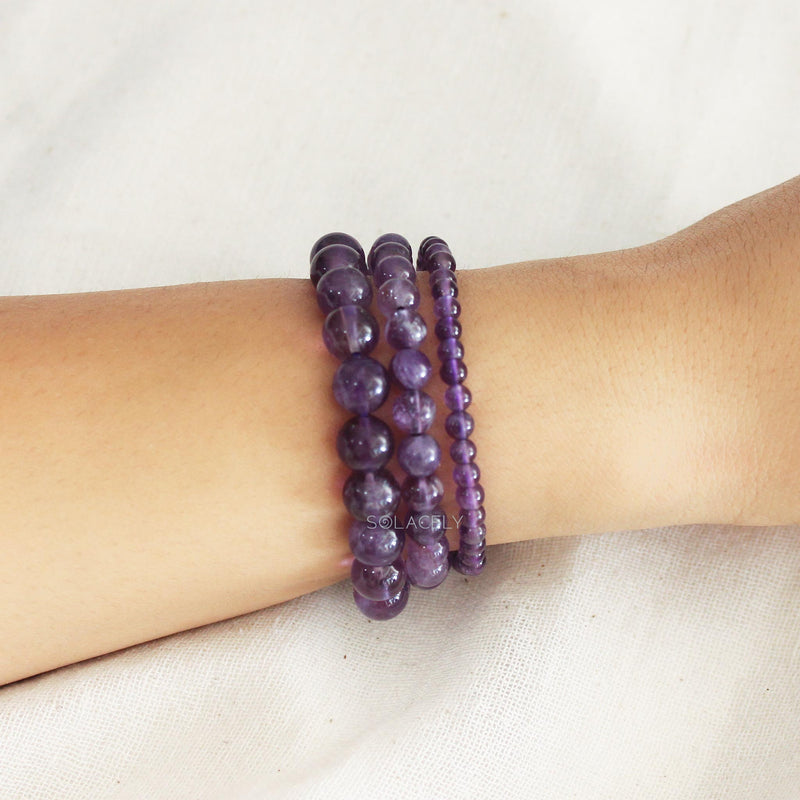
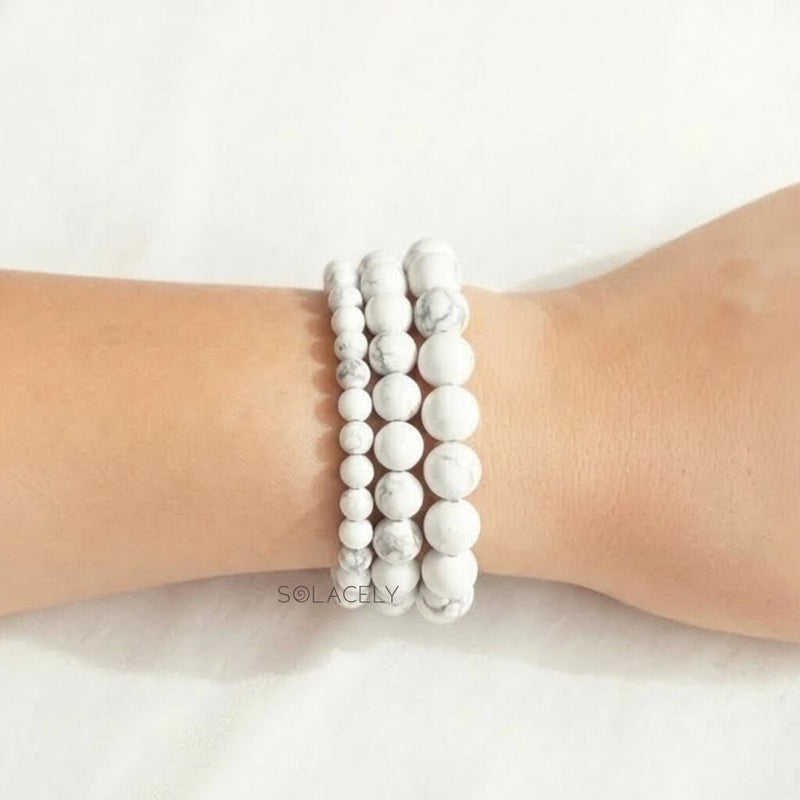
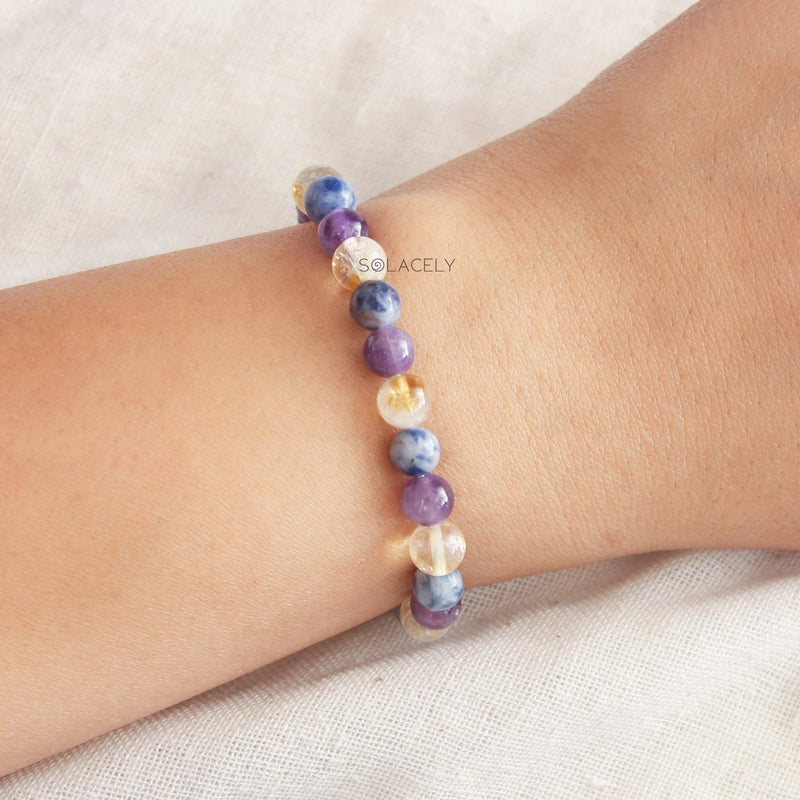
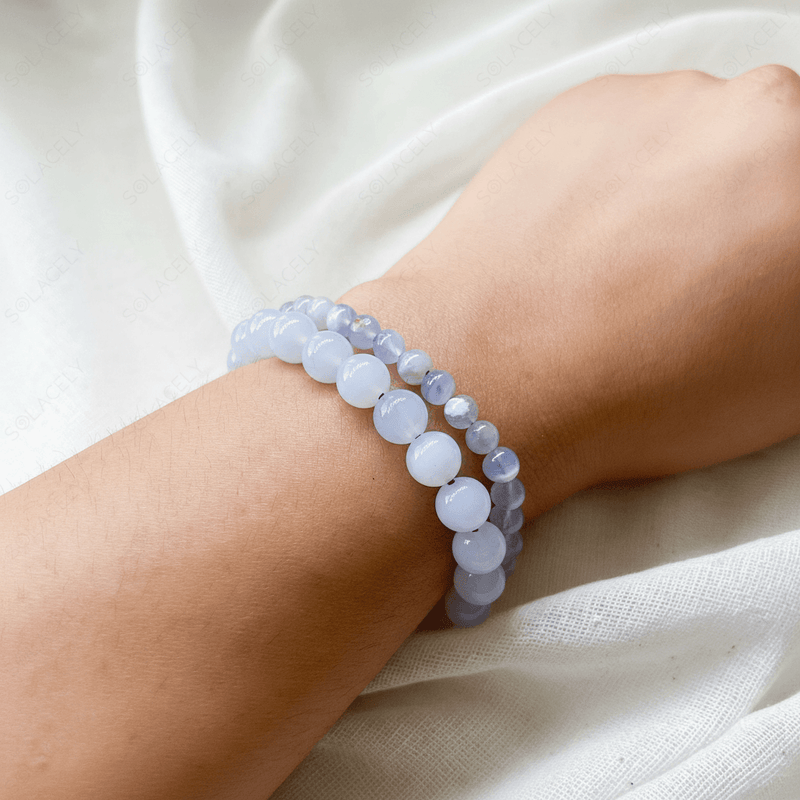
Amethyst, howlite, lepidolite and blue lace agate are the four stones most often kept close for anxiety. In crystal tradition these are the calming stones, and people reach for them at the moments anxiety tends to arrive: last thing at night, before a room full of people, in the middle of a day that has got away from them.
Key takeaways
- The four traditional calming stones: amethyst, howlite, lepidolite, blue lace agate.
- Amethyst and howlite are the bedside choices for a mind that will not switch off.
- Hold the stone and describe it to yourself, then breathe out longer than you breathe in.
- Keep it reachable in seconds. A beautiful piece in a display case is no use in the moment.
- Held as company alongside your doctor's care, never instead of it.
The four stones and when people reach for them
| Stone | Traditionally kept for | Where people keep it |
|---|---|---|
| Amethyst | A mind that will not settle at night | Bedside table, under a pillow |
| Howlite | Racing thoughts, particularly at bedtime | Bedside, or a pocket for the commute |
| Lepidolite | Steadiness through an unsettled stretch | Worn daily, or carried in a bag |
| Blue lace agate | Calm before speaking or being seen | A pendant, or held before going in |
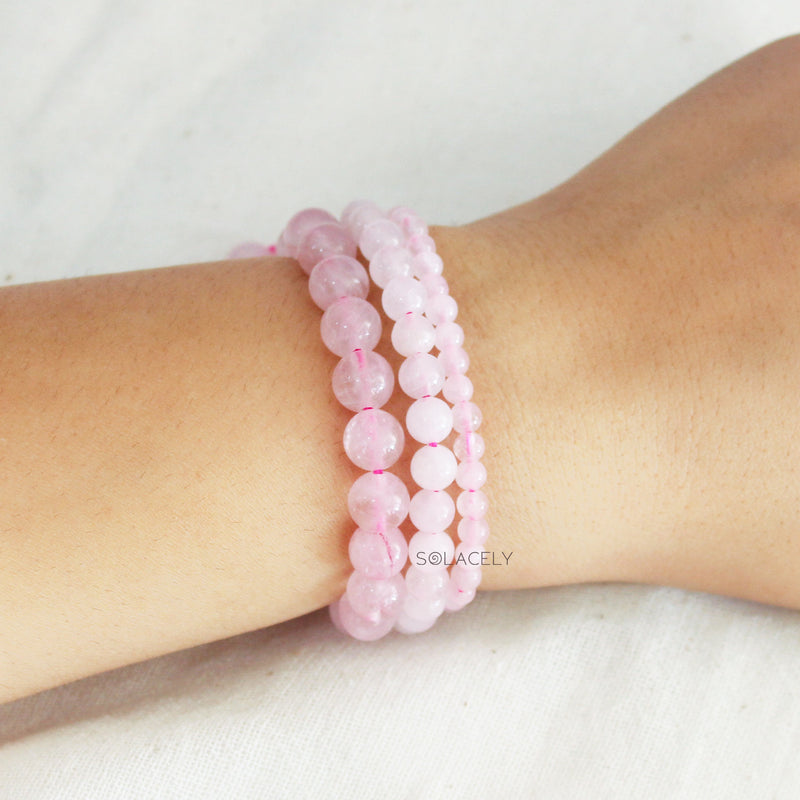
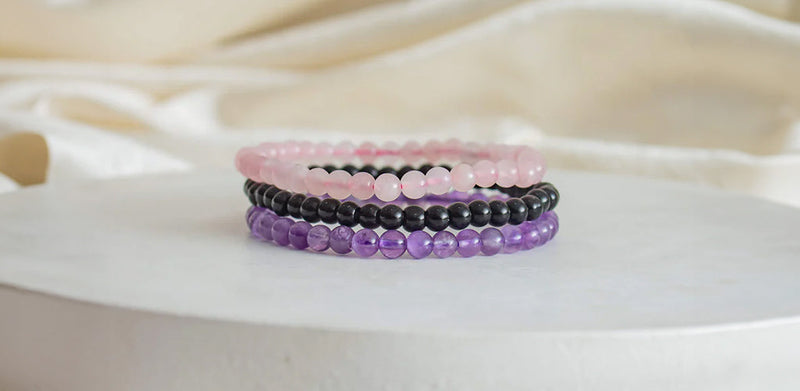
| Rose quartz | Kindness toward yourself afterwards | Worn on the wrist |
| Black tourmaline | When it is other people's mood you are carrying | Pocket, or by the front door |
Amethyst is where most people start, and it is the one that stays. It is the purple variety of quartz, hard enough for daily wear, and its association with clear headedness and calm goes back to Greek usage. Our crystals for anxiety and self-love guide covers the pairing of a calming stone with a self-regard one, which many people find is what they actually need.
Holding a stone in the moment
This is the practice people describe most, and it takes about ninety seconds.
- Get the stone into your hand. This is why reachability matters more than beauty.
- Describe it silently. Cool or warm. Heavy or light. Smooth, ridged, faceted. What colour, exactly, in the light you are in.
- Name three more things you can feel. The chair, the floor, fabric against your arms.
- Breathe out longer than you breathe in. Four in, six or seven out. Five rounds.
- One plain sentence. Something true and undramatic: this passes, and I do not have to be good at this.
The stone's job here is to give your attention somewhere solid to go while the wave moves through. That is why a smooth tumbled piece works better than anything sharp or fussy, and why the piece you actually use is usually the plainest one you own.
Night-time, which is when most people need it
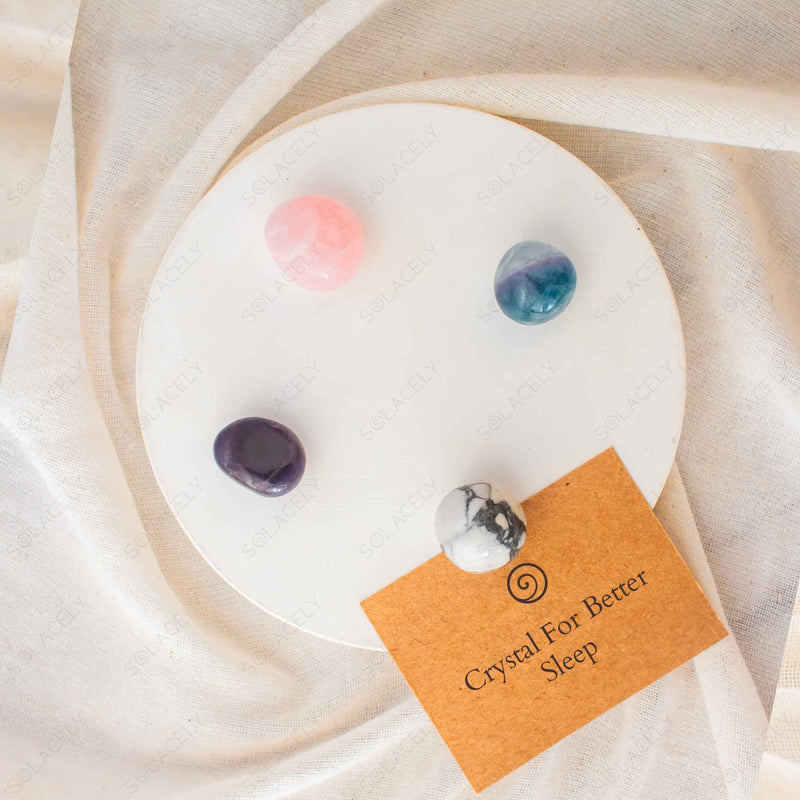
Anxiety has a habit of waiting until the lights are out. Amethyst and howlite are the traditional bedside pair for exactly that, and the placement is simple: on the bedside table where you can reach it without sitting up, or under the pillow.
A few things help the practice along. Keep the piece uncluttered by a pile of other stones, so there is one obvious thing to reach for. Put it in place as part of getting into bed rather than mid-episode. And pair it with the same breathing pattern you would use in the day, so your body already knows the shape of it.
Our crystals for sleep guide covers the bedroom set in more detail, and crystals for negative thinking covers the thought loops that often come with it.
Where to keep them
This decides whether the practice works at all, and it is the part most guides skip.
A crystal you have to go and find is a crystal you will not use. The people who get the most from this keep several inexpensive tumbled stones in the places anxiety actually turns up: the coat pocket, the front compartment of a bag, a desk drawer, the car, the bedside. The nicer specimen stays at home and does a different job.
There is nothing disrespectful about a working set of cheap tumbles. It is the difference between a practice you own and a practice you use. Our crystals for anxiety and stress guide covers the daytime version of the same idea.
Building something steadier
Beyond the in-the-moment use, most people settle into a quieter daily habit: a stone worn on the wrist, touched deliberately when they notice the first tightening rather than waiting for the peak.
Catching it early is the part worth practising. Anxiety is much easier to sit with at a three than at an eight, and a worn stone you can touch without anyone noticing is well suited to that. Lepidolite and amethyst are the usual choices for a piece worn every day.
Where self-criticism follows the anxiety, which it very often does, rose quartz or rhodonite is traditionally added, and our crystals for emotional healing guide covers that side.
Caring for these stones
Amethyst is quartz at 7 on the Mohs scale and takes warm water and a soft cloth easily, though it will pale with long spells of direct sun, so charge it in moonlight or indirect light instead.
Howlite is softer, around 3.5, and marks easily, so store it on its own. Lepidolite is softer still and flakes along its layers, so handle it gently and keep it dry. Blue lace agate is the toughest of the four and the least demanding.
For energetic cleansing, sound, smoke, moonlight or a rest on selenite all suit the group. Weekly suits a stone carried every day.
Crystals are offered here for reflection and wellbeing as part of a long standing tradition. They are not a treatment for anxiety, panic disorder or any other condition, and they are not a substitute for professional care. Anxiety disorders are common and very treatable: if anxiety is affecting your sleep, work or relationships, or you are having panic attacks regularly, please speak to a qualified healthcare professional. In a crisis, contact your local emergency service or a crisis line. Lepidolite contains lithium as part of its mineral structure and is in no way related to, or a replacement for, lithium medication.
Sources
- National Institute of Mental Health, Anxiety Disorders
- NCCIH, Relaxation Techniques: What You Need To Know
Written by Chetena Sharma. Reviewed by the Solacely editorial team.
Frequently asked questions
About the author


Written by Chetna Sharma, crystal healing practitioner and co-founder of Solacely. Chetna has worked with healing crystals for over a decade and curates Solacely's protective stone collection.