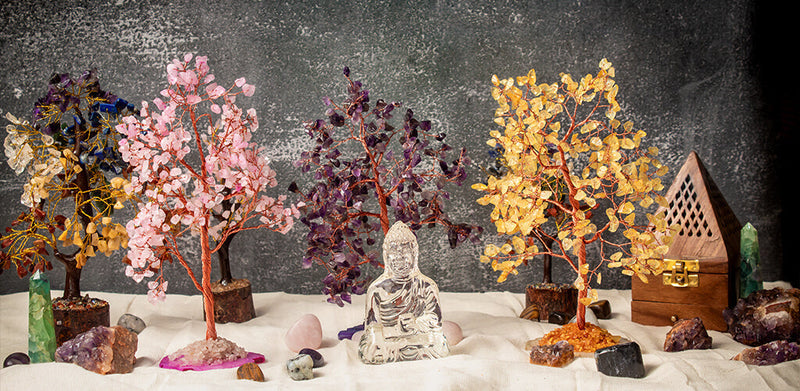
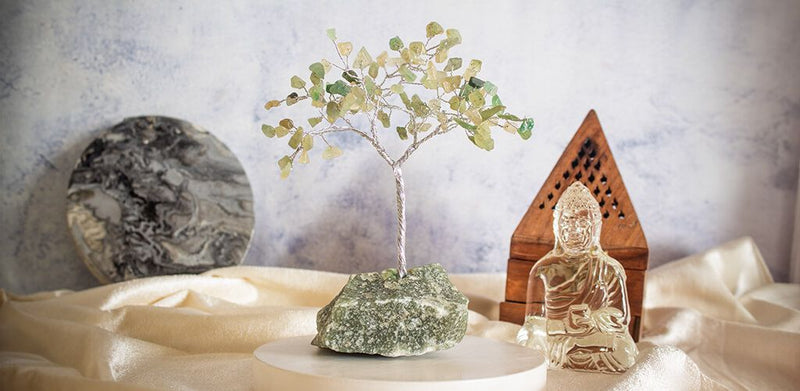
A crystal tree sculpture is a decorative art object: fine wire branches, usually brass or copper, hold dozens of tumbled gemstone chips over a natural stone or geode base, built to sit on a shelf, desk, or console as a small sculptural centrepiece. Most buyers land in the mid range, with statement pieces climbing higher.
Key Takeaways
- Treat a crystal tree first as sculpture: judge it on wirework, chip quality, base, and balance, then let the stone's meaning follow.
- Common types by stone: amethyst (calm, purple), citrine (abundance, gold), rose quartz (love, pink), green aventurine (luck), clear quartz (neutral), and seven-chakra (mixed colour).
- Typical tiers: Entry small (15–20 cm), Mid range medium, the premium tier for large or agate-slice statement pieces.
- The 20–25 cm size on a solid base is the practical sweet spot for a shelf or work desk.
- Care is simple: dust with a soft brush, avoid harsh cleaners on glued chips, and keep bright stones like amethyst and rose quartz out of long direct sun to prevent fading.
What is a crystal tree sculpture?
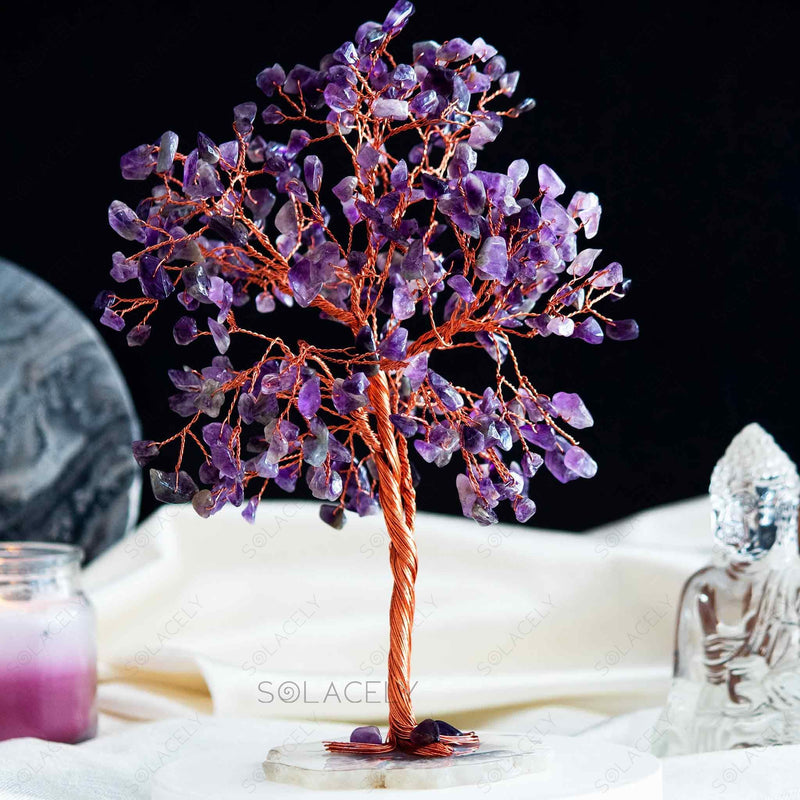
A crystal tree sculpture, sometimes called a gemstone tree or bonsai tree, is a handcrafted ornament: twisted metal wire forms a trunk and branches, tumbled crystal chips are threaded on as 'leaves,' and the whole thing anchors into a base of natural stone, geode, or wood. It reads as a small piece of sculpture rather than a mere trinket.
The form borrows from the East Asian 'money tree' and Feng Shui tradition, where a stylised tree stands for growth and abundance. In modern homes it lands differently. People buy it as décor first, a compact, sparkly object that catches light on a bookshelf or study desk, with the crystal symbolism as a quiet bonus.
That is the useful way to think about these pieces. You are buying craftsmanship and colour that happens to carry intention. For the wider category and how these trees fit alongside other gemstone décor, our overview of crystal trees sets the scene, and this guide focuses on choosing and styling them as art objects.
The craftsmanship: what separates a good tree from a cheap one
Judge a crystal tree the way you would any handmade object: on the wirework, the chips, and the base. Good trees use many fine, evenly twisted wires that fan into a full, rounded canopy, chips of consistent size and real colour, and a heavy, flat base that keeps the piece from tipping. Thin wire, bald patches, and a light plastic base signal a rushed piece.
Start with the branches. A well-made tree has 50 to 200-plus wire strands, each holding several chips, worked into a shape that looks full from every angle. Cheap trees skimp on wire, so the canopy looks sparse and you can see straight through it. Bend-test in your mind: branches should hold their shape, not droop under the weight of the stones.
Then the stones. Quality chips are tumbled smooth, roughly matched in size, and show honest, slightly varied colour. According to the Gemological Institute of America, quartz occurs naturally in many colour varieties, so genuine amethyst or citrine chips show gentle variation, not a flat, uniform dye. Suspiciously neon, perfectly even colour often means dyed glass or low-grade stone.
Finally the base. The best trees root into a natural agate slice, an amethyst geode cluster, or a polished stone, which adds weight, stability, and a second material to enjoy. A raw crystal base is both prettier and more stable than moulded resin. If the tree wobbles or the trunk feels loosely set, walk away.
Types of crystal tree sculptures by stone
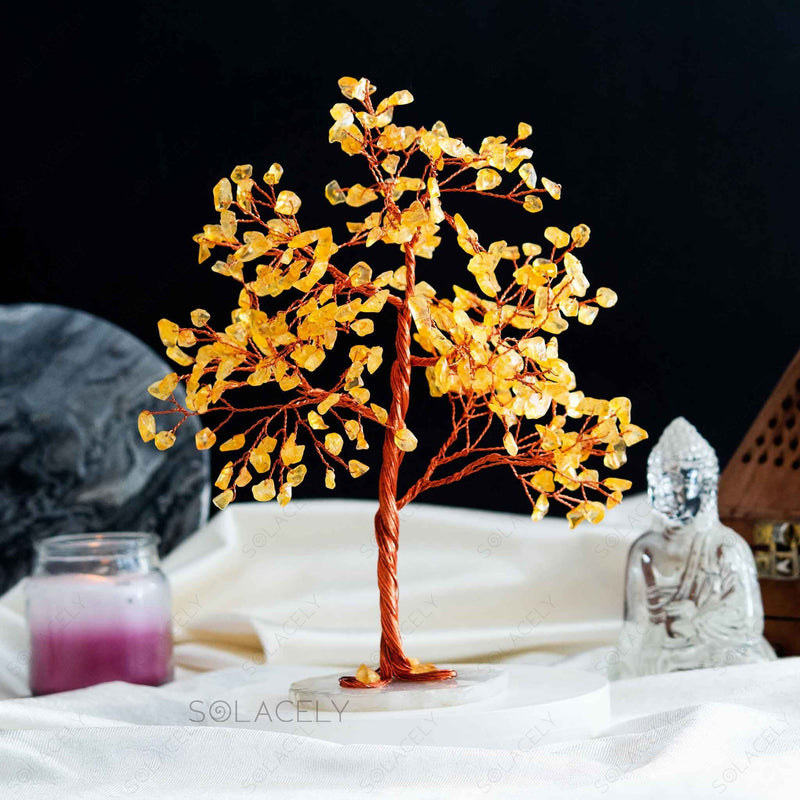
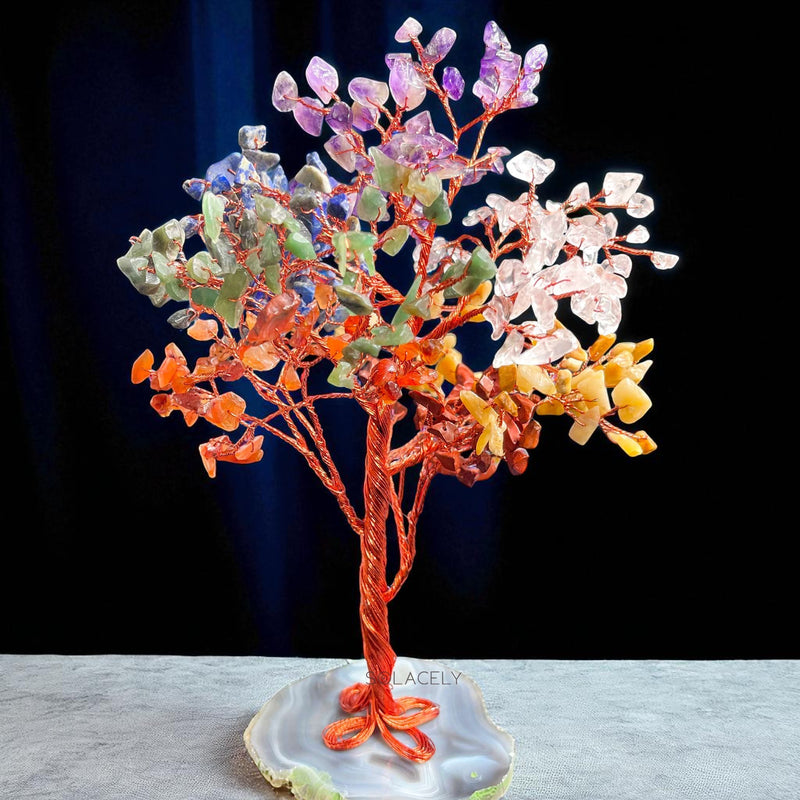
The stone sets both the colour and the traditional meaning, and it is the first thing most buyers choose by. Amethyst reads calm and purple, citrine warm and golden, rose quartz soft pink, green aventurine fresh and lucky, clear quartz neutral and versatile, and seven-chakra trees mix all colours into a rainbow canopy. Pick by the room's palette and the intention you like.
Each stone gives the piece a different personality on the shelf. Here's how the popular varieties compare for décor and meaning.
| Tree (stone) | Colour on the shelf | Traditional intention | Suits |
|---|---|---|---|
| Amethyst | Deep to soft purple | Calm, clarity, rest | Bedrooms, meditation corners, study |
| Citrine | Warm gold to honey | Abundance, confidence | Work desks, cash counters, entryways |
| Rose Quartz | Soft blush pink | Love, warmth, harmony | Bedrooms, living rooms, gifting |
| Green Aventurine | Fresh mid-green | Luck, opportunity, growth | Offices, plant corners, new ventures |
| Clear Quartz | Icy, sparkling neutral | Clarity, focus | Any palette, minimalist interiors |
| Seven Chakra | Full rainbow mix | Balance across the chakras | Yoga rooms, colourful, eclectic spaces |
For the two most popular choices, we go deeper on the amethyst tree and the citrine tree in their own guides, including how the colour behaves in different light. Amethyst is a variety of quartz coloured by iron and natural irradiation, which is why its purple ranges from pale lilac to deep grape, useful to know when you match a tree to a room.
Sizes and tiers: what you get for your budget
Crystal tree sculptures run from roughly 12 cm desk minis to 30 cm-plus statement pieces, and price tracks size, stone, base, and wire count. expect the entry tier for small trees, the mid tier for medium, and Premium or more for large trees on agate or geode bases. Size and base quality move the price more than the stone type does.
Bigger is not automatically better. A dense, well-made 20 cm tree on a solid agate slice looks far richer than a tall, sparse 30 cm one on plastic. Match the size to where it will sit, then spend on canopy fullness and base quality within that size.
| Tier | Typical size / build | Best for |
|---|---|---|
| Entry | 12–18 cm, lighter base, fewer branches | Desks, small shelves, first buy, gifting |
| Mid range | 18–25 cm, agate or stone base, full canopy | Living-room shelf, study, main décor piece |
| Premium | 25–30 cm+, geode/large agate base, dense wirework | Console, entryway, statement or luxury gift |
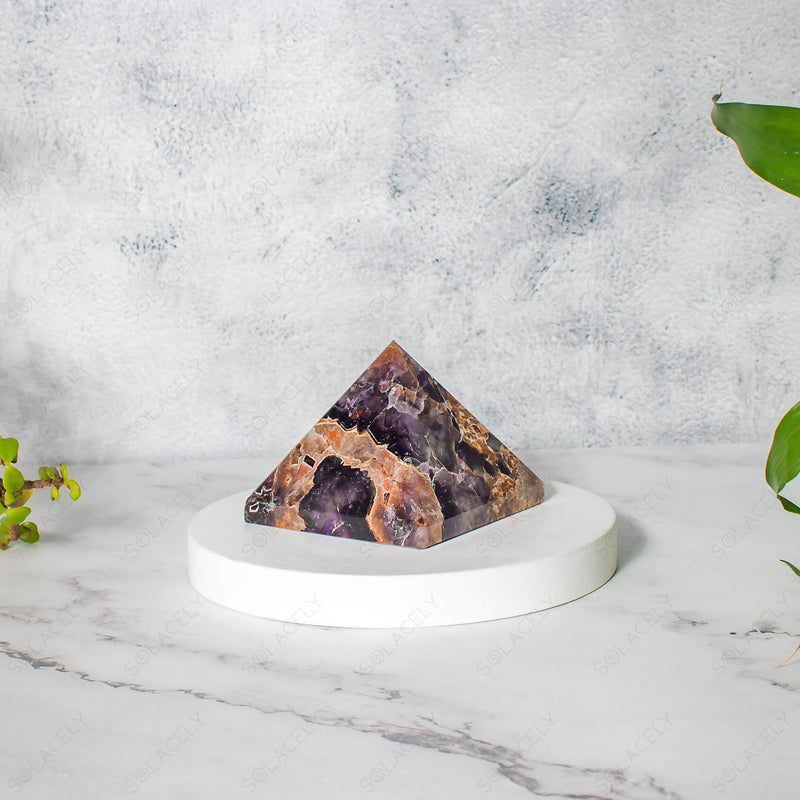
The 20–25 cm size is the sweet spot for most homes: substantial enough to anchor a shelf, small enough not to crowd it. If you want a broader tour of décor formats and where trees sit among them, our crystal tree decor guide compares trees with clusters, pyramids, and other pieces.
Styling and placement: where a crystal tree looks best
Style a crystal tree like a small sculpture: give it a clear surface, a little breathing room, and light that makes the chips glint. The best spots are a study or work desk, a bookshelf at eye level, an entryway console, or a bedside table. Keep it away from cramped, high-traffic edges where a passing sleeve can knock it over.
Placement can nod to tradition without turning your home into a grid. Feng Shui associates the southeast with wealth, so many people set a citrine or green aventurine tree there, on a desk or near the entrance, as a growth cue. It is a nice intention to layer on, but the object earns its place on looks alone.
A few styling moves that consistently work:
- Odd-number groupings. A tree looks best beside one or two other objects, a book stack, a small vase, a candle, not lost in a crowded shelf.
- Backlight it. A nearby lamp or window makes the chips sparkle. Just avoid all-day direct sun on bright stones.
- Give it a tray or coaster. A small brass or wooden tray defines its space and catches the base.
- Match the metal. Brass-wire trees sit well with warm, wooden interiors, silver-tone wire with cooler, minimalist ones.
- Mind the scale. A 15 cm tree disappears on a large console; save minis for desks and bedsides.
For a smaller, on-the-go version of the same idea, crystal car charms carry the same intention into a car, which pairs nicely with a matching tree at home.
How to buy: authenticity, checks, and where to spend
Buy on build quality and honest sourcing, not on the lowest price. Ask what stone the chips are and whether the colour is natural or dyed, check that the base is genuine stone rather than moulded resin, and inspect the canopy for full, even coverage. A trustworthy seller will name the stone plainly and show clear, un-retouched photos.
Real tumbled chips feel cool and slightly heavy, show subtle colour variation, and have smooth, natural surfaces. Dyed or glass chips look uniformly neon, feel light, and sometimes show colour pooled in cracks. Green aventurine, for instance, gets its colour from tiny mineral inclusions like fuchsite, so genuine chips have a soft, slightly sparkly green, not a flat plastic tone.
Where should the money go? Prioritise, in order: a heavy natural base, a full canopy with plenty of wire, then chip quality, then size. A quick pre-purchase checklist:
- Confirm the stone and colour treatment before you pay.
- Check the base sits flat and has real weight.
- Look through the canopy, bald patches mean too little wire.
- Tug-test the trunk where it meets the base; it should feel firmly set.
- Compare size to your shelf, not just to the photo.
Amethyst and citrine remain the most-gifted trees partly for their meanings and partly because purple and gold flatter most interiors. If you want the reasoning behind the calm-and-clarity choice, the amethyst tree benefits guide explains the tradition without overclaiming.
Caring for a crystal tree sculpture
Care is light but specific, because the chips are glued and wired, not solid stone. Dust weekly with a soft, dry makeup or paint brush to reach between branches, wipe the base with a barely damp cloth, and skip soaking, harsh chemicals, and ultrasonic cleaners, which loosen glue and wire. Keep bright stones out of long, direct sunlight to stop the colour fading.
The glue and wire are the fragile parts. Never submerge the tree or run it under a tap, water seeps into the joins and lifts chips over time. If a chip comes loose, a dot of clear craft glue re-sets it. Reshape any bent branch gently with your fingers rather than forcing it.
Sunlight is the quiet enemy of colour. Amethyst and rose quartz can fade with months of harsh, direct sun, so a spot with bright indirect light keeps them vivid. Many owners like to 'refresh' the piece under moonlight or with sound now and then; that is a personal, traditional ritual rather than a cleaning need. Handle the tree by its base, not its branches, and it will hold up for years.
Sources
- Gemological Institute of America — Quartz description and colour varieties: gia.edu/quartz
- Encyclopaedia Britannica — Amethyst (quartz variety): britannica.com/science/amethyst
- Mindat.org — Aventurine (quartz variety) mineral data: mindat.org/min-451.html
Frequently asked questions
About the author


Written by Chetna Sharma, crystal healing practitioner and co-founder of Solacely. Chetna has worked with healing crystals for over a decade and curates Solacely's protective stone collection.