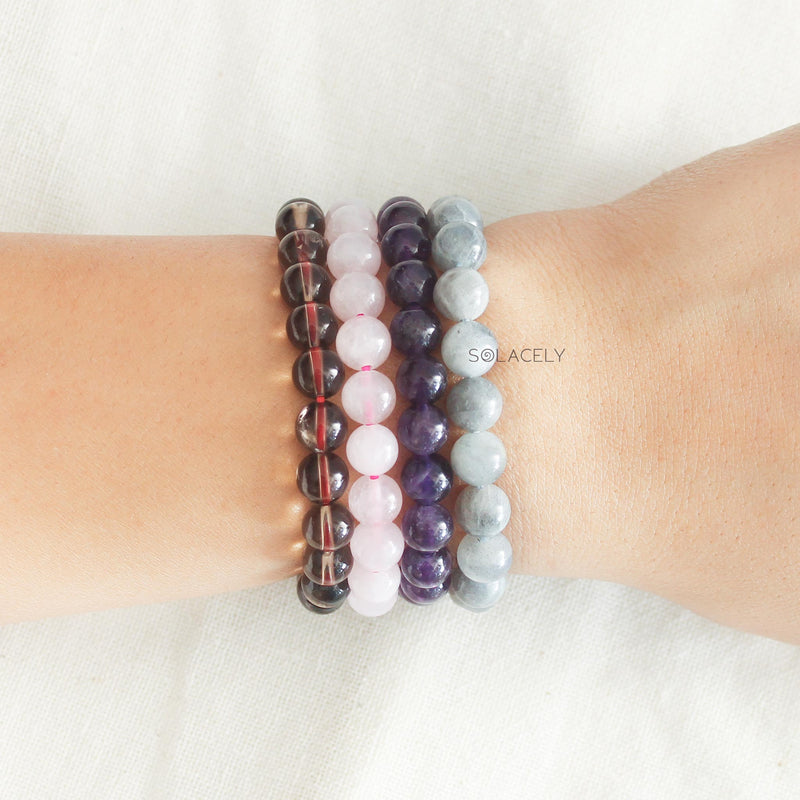
Amethyst and labradorite are paired because they do different halves of the same job. Amethyst is kept for quiet and settling an overactive mind; labradorite for reading a room without carrying it home. The set suits people who are not anxious so much as permeable.
Key takeaways
- Amethyst quiets, labradorite filters. One works inward, the other at the boundary with other people.
- Labradorite's flash, called labradorescence, comes from light interference between microscopic layers inside the feldspar.
- Amethyst is quartz at 7 on the Mohs scale; labradorite is softer at 6 to 6.5 and has cleavage planes.
- Store them apart, since amethyst will scratch labradorite.
- Keep amethyst out of long strong sun, and keep labradorite out of ultrasonic cleaners.
Why the pairing works
Most people who reach for this combination describe the same thing in different words: they finish a day carrying moods that were never theirs. That is a specific complaint, and it is not the same as anxiety, which is why a purely soothing stone often feels beside the point.
Labradorite is the traditional answer to it. It is kept for perceiving accurately while staying separate, which suits anyone whose work or family life involves absorbing a lot of other people's weather. Amethyst then handles what is left over at the end of the day, when the noise has to settle.
Together the two cover the whole arc: through the day, then afterwards. For the wider set of stones kept for perception, see crystals for the third eye.
What labradorite actually is
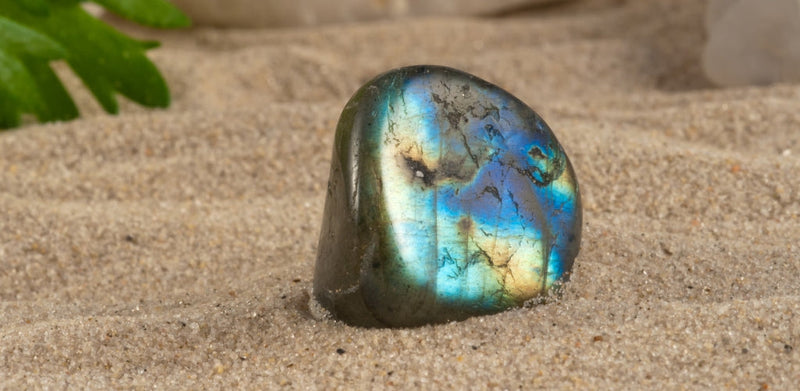
Labradorite is a plagioclase feldspar, and its entire appeal is optical. The Gemological Institute of America attributes the flash to light interference between microscopic layers within the stone, an effect named labradorescence after the mineral itself.
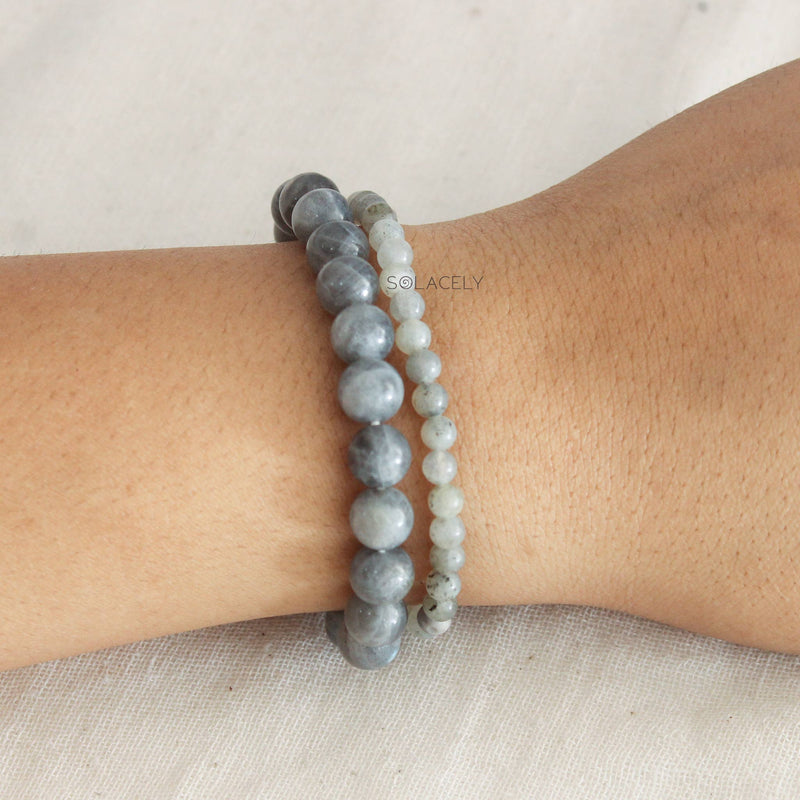
Two consequences follow, and both matter for wear. The flash only shows at certain angles, so a labradorite piece looks plain grey until it moves and then lights up in blue, gold or green. And because the effect depends on movement, a bracelet does far more with the stone than a piece sitting still on a shelf.
It is also the more fragile half of this pair. At 6 to 6.5 on the Mohs scale, with the cleavage planes common to all feldspars, a sharp knock can split a piece that has survived years of gentle wear. The labradorite guide covers it fully.
What amethyst brings
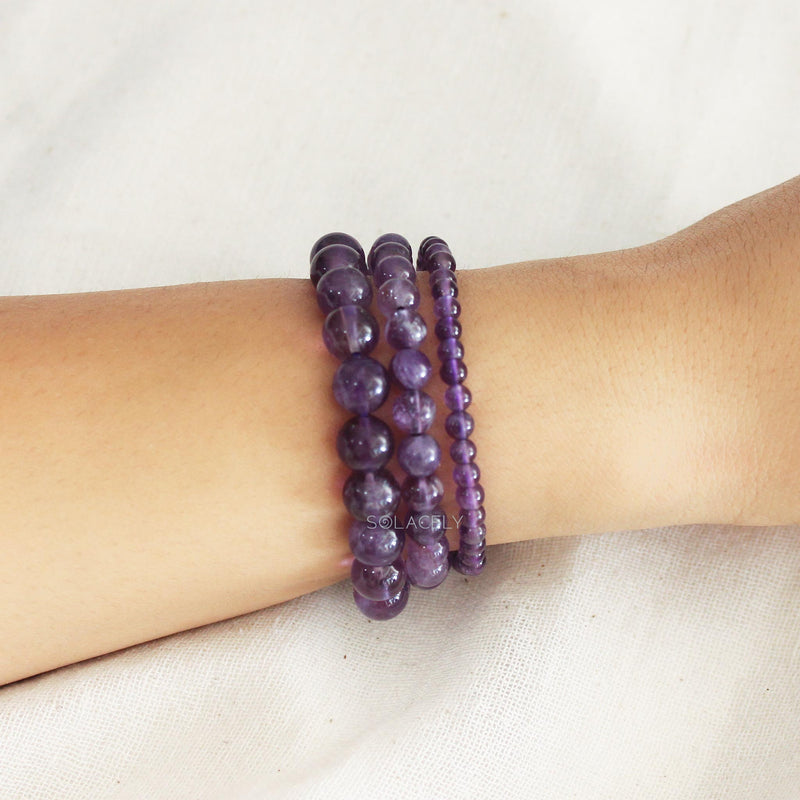
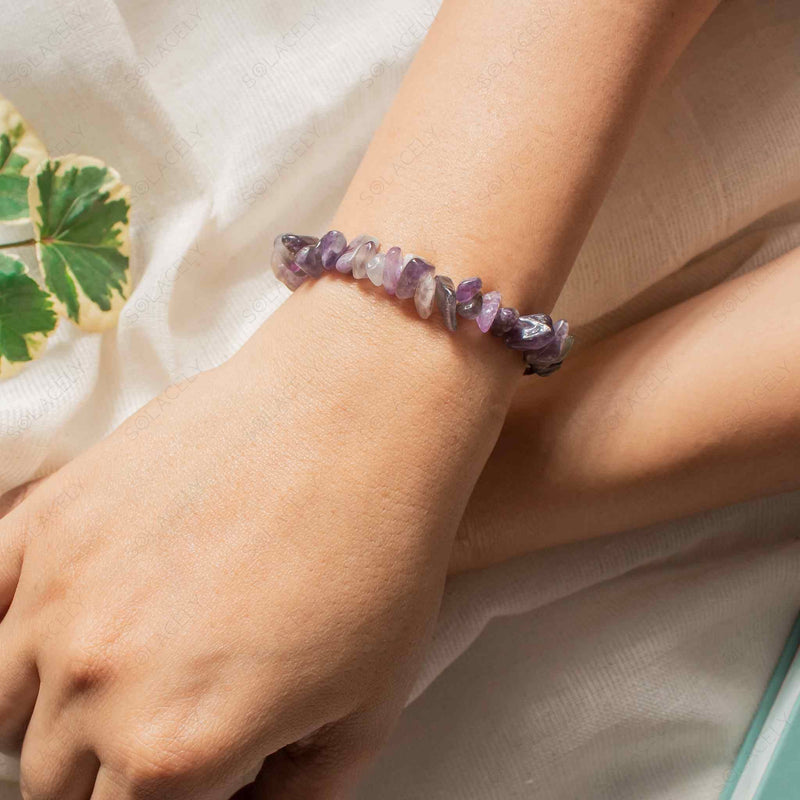
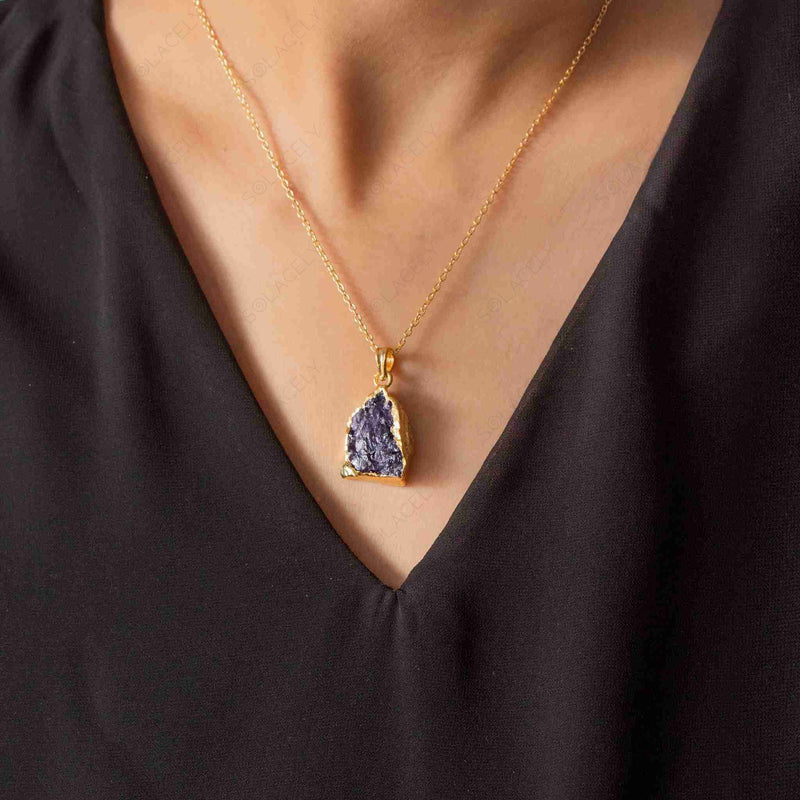
Amethyst is the purple variety of quartz, coloured by iron within the crystal structure. At 7 on the Mohs scale with no cleavage, it is one of the most forgiving stones in a collection and it survives daily wear in any format without special handling.
Its role in this pairing is narrower than amethyst's general reputation suggests. Here it is the evening stone: the one that marks the end of a demanding day, kept on a nightstand or held for a few slow breaths once the work is finished. That framing makes it far more useful than treating it as a general purpose calming object.
The single care note is light. Long hours of strong direct sun soften the purple over months, so keep it back from a bright sill. The amethyst guide covers the varieties and their colour ranges.
Comparing the two
| Amethyst | Labradorite | |
|---|---|---|
| Mineral | Quartz, coloured by iron | Plagioclase feldspar |
| What you are buying | Depth and evenness of purple | Strength and spread of the flash |
| Hardness | 7 Mohs, no cleavage | 6 to 6.5 Mohs, distinct cleavage |
| Traditionally kept for | Quiet, settling, the end of a day | Perception, staying separate |
| Best format | Anything, including daily rings | Bracelet or pendant, where it moves |
| Avoid | Prolonged direct sunlight | Ultrasonic cleaners, sharp knocks |
The hardness gap is the practical headline. Amethyst will scratch labradorite if the two share a pouch, so give the softer stone its own space and check anything new against the Mohs hardness scale before storing them together.
How to wear the pair
Give labradorite the position where it will move and amethyst the position where it will be seen at the right moment.
- Labradorite on the wrist. The flash needs movement, so a bracelet earns far more from the stone than a pendant does.
- Amethyst at the bedside. Kept where the day ends rather than where it happens.
- Both worn together. A single alternating strand works, though expect the labradorite beads to dull slightly before the amethyst does.
- Before a demanding conversation. Labradorite held for a few slow breaths, which is the moment the stone is traditionally reached for.
One habit worth adopting is swapping which stone sits closest to hand as the week changes. A heavy stretch of meetings puts labradorite in the pocket; a quiet week where sleep is the difficulty puts amethyst by the bed. Letting the set move keeps each stone attached to a specific job rather than blurring into general decor.
If buying one first, choose by which problem is louder. Amethyst if the difficulty is a mind that will not stop; labradorite if the difficulty is other people. Adding the second when the need is genuinely clear works better than buying both and giving neither a specific job.
Choosing a labradorite worth having
Labradorite is inexpensive enough that you can afford to be choosy, and the difference between a dull piece and a good one is considerable. Tilt any piece under a single light source and watch how far the flash travels across the surface.
A strong piece lights up across most of its face as it turns. A weak one shows a narrow band that appears at one angle and vanishes. Both are genuine labradorite, so this is a question of quality rather than authenticity, and the price difference between them is usually small.
Colour is largely a matter of taste. Blue is the most common and the most affordable, gold and green flashes are less usual, and material showing several colours at once carries a premium. Buy what you will actually enjoy looking at, since that is the whole point of this particular stone.
Care and cleansing
Warm water, mild soap, a soft cloth and a full dry suits both stones. Neither needs anything more elaborate, and neither should go near a household cleaner.
Labradorite is the one with rules. Never use an ultrasonic or steam cleaner on a feldspar, since the cleavage makes it vulnerable to vibration, and store it away from quartz and harder beads. A weekly wipe keeps the flash bright, since the effect depends on a clean surface.
For energetic cleansing, moonlight or sound suit both. Skip prolonged sunlight, which is unkind to amethyst's colour and does labradorite no favours either. For a related pairing built on the same filtering idea, see blue apatite and labradorite.
The properties described here reflect traditional and cultural belief around crystals. They are offered for reflection and wellbeing and are not medical advice, a diagnosis, or a treatment for any condition. If you are managing a health or mental health concern, please speak with a qualified practitioner. Keep small stones away from young children, and never place crystals in drinking water.
Sources
Written by Chetena Sharma. Reviewed by the Solacely editorial team.
Frequently asked questions
About the author


Written by Chetna Sharma, crystal healing practitioner and co-founder of Solacely. Chetna has worked with healing crystals for over a decade and curates Solacely's protective stone collection.