Your moon sign is the zodiac sign the Moon occupied at the moment you were born, and in astrology it holds the inward half of a chart: how you feel, what settles you, how you recover. Sun sign stones speak to how you show up in the world. Moon sign stones speak to what you need when nobody is watching, which is why they tend to be the ones people keep by the bed.
Key Takeaways
- Your moon sign is where the Moon sat at your birth. You need date, time, and place to find it.
- Birth time matters, because the Moon changes sign roughly every two and a half days.
- Moon sign stones speak to emotional needs; sun sign stones to outward expression.
- Moonstone earns its name from adularescence, the soft blue-white glow inside the stone.
- Moonlight is the gentler way to charge stones, since it will not soften the colour of amethyst or rose quartz.
Finding your moon sign
Most people know their sun sign, because it only takes a birthday. The moon sign asks for a little more. The Moon travels the whole zodiac in roughly a month, spending about two and a half days in each sign, so two people born on the same date a few hours apart can carry different moon signs.
You need three things: date of birth, time of birth, and place of birth. Any birth chart calculator will do the rest in a moment. If you do not know your exact birth time, an approximate one usually narrows it enough, and a birth certificate or a parent's memory settles it.
It is worth doing properly, because the moon sign is often the one people recognise themselves in most. The sun sign describes the version of you that other people meet. The moon sign describes the one that goes quiet at the end of a long week.
A stone for each moon sign
The pairings below follow the common associations in crystal and astrological tradition, matched to what each moon sign is said to reach for.
| Moon sign | What it reaches for | Stone |
|---|---|---|
| Aries | To move, and to cool down after | Carnelian |
| Taurus | Steadiness and physical comfort | Rose quartz |
| Gemini | A quieter mind | Blue lace agate |
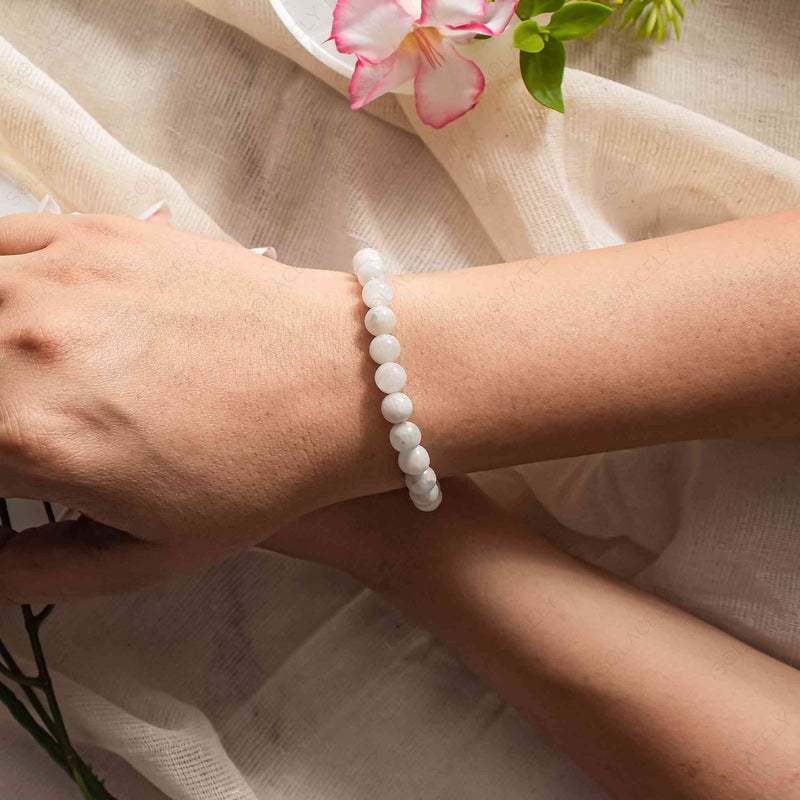
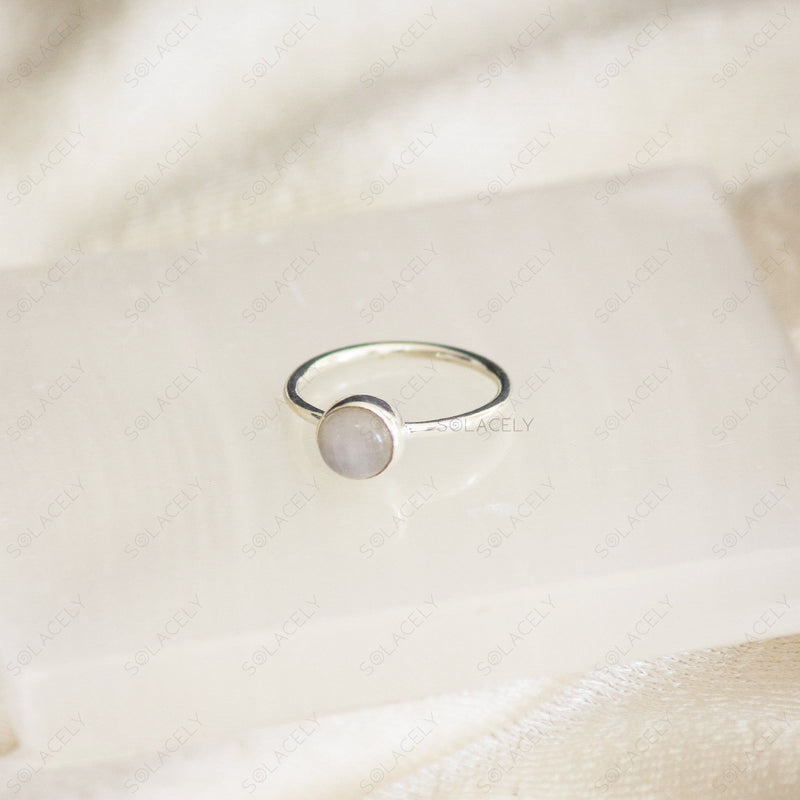
| Cancer | Safety and softness | Moonstone |
| Leo | To be genuinely seen | Citrine |
| Virgo | Relief from self-criticism | Amazonite |
| Libra | Balance without self-erasure | Lepidolite |
| Scorpio | Somewhere safe for intensity | Black obsidian |
| Sagittarius | Room, and something to aim at | Sodalite |
| Capricorn | Permission to stop working | Smoky quartz |
| Aquarius | Space to think differently | Labradorite |
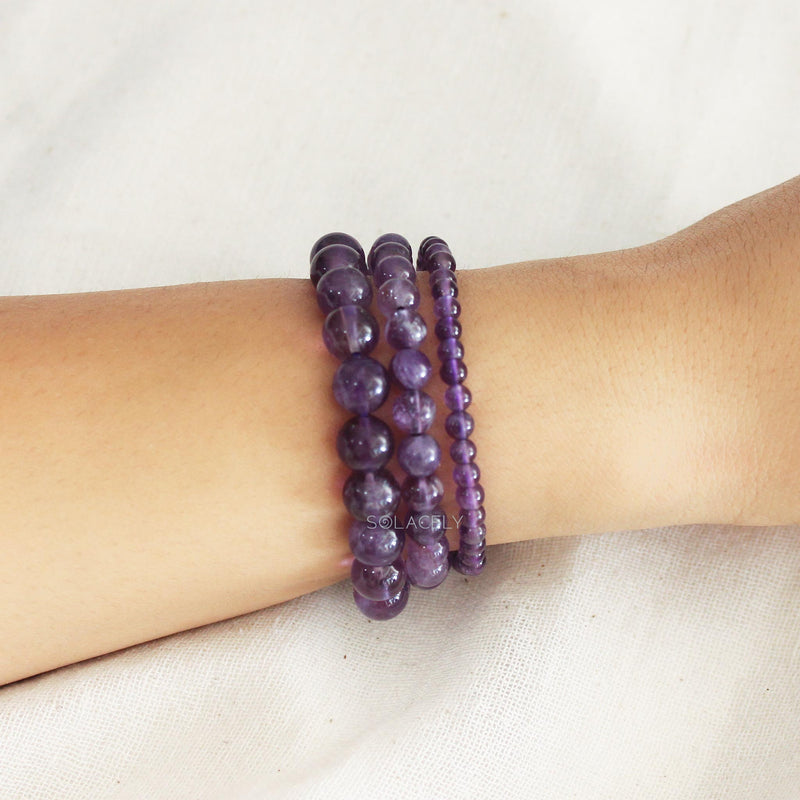
| Pisces | A boundary around the feeling | Amethyst |
If your moon sign stone and your sun sign stone differ, that is normal and rather the point: the two halves of a chart want different things. Our guide to crystals for zodiac signs covers the sun sign half.
Moonstone, and where its glow comes from
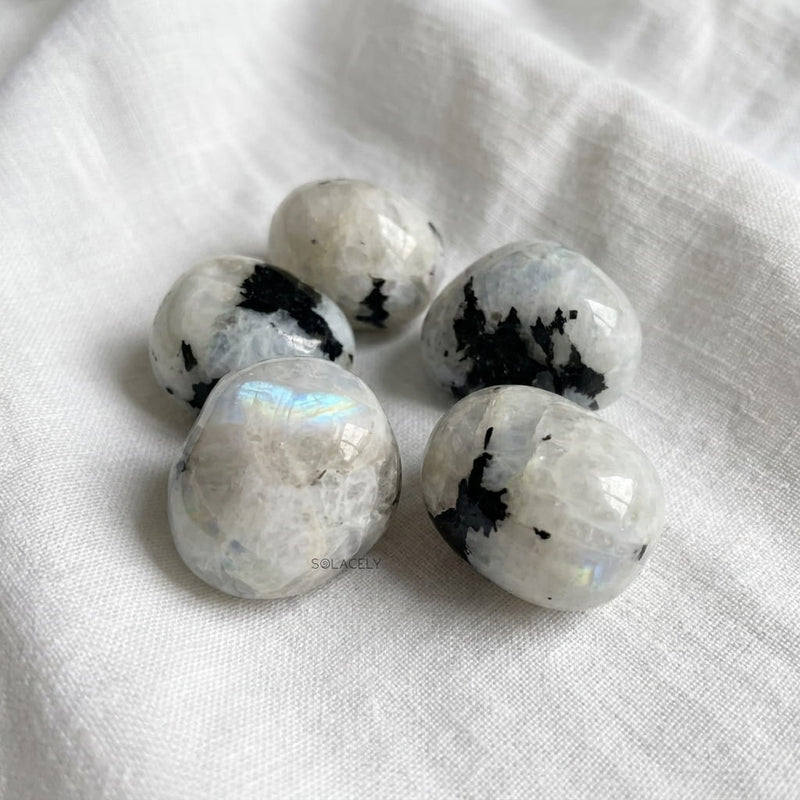
Moonstone earns its place in this article more than any other stone, so it is worth knowing what gives it that quality in the hand. It is a feldspar, and its soft blue-white shimmer is called adularescence, caused by light scattering between microscopic layers within the stone.
Encyclopaedia Britannica describes the effect, and once you know it you notice it: the glow seems to move across the surface as you tilt it, lit from somewhere inside rather than reflected off the top. That quality is exactly why it was named for the Moon, and why it belongs to this half of the chart.
One care note. Moonstone sits around 6 to 6.5 on the Mohs scale, softer than quartz, with cleavage planes that can split on a sharp knock. Keep it as a pendant or a bedside stone rather than loose in a bag with keys.
Working with the lunar cycle
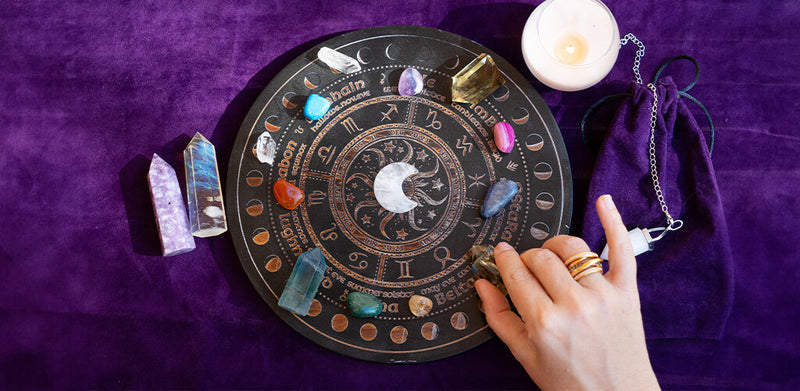
Many moon sign practices attach to the lunar cycle: setting intentions at the new moon, releasing what you are carrying at the full. The cycle runs about 29.5 days, as NASA describes, and its great virtue as a calendar is that you never have to remember it. You look up and it tells you where you are.
That makes it a lovely rhythm to hang a check-in on. Twice a month, take your moon sign stone, sit down, and write two lists: what you are starting, and what you are ready to put down. Ten minutes, twenty-four times a year, and you end up with a record of a year that most people never keep.
Charging stones in moonlight follows the same rhythm. Leave them out overnight on a full moon, somewhere sheltered from rain. It is the gentler of the two options, and it has a real practical advantage over sun charging: amethyst, citrine, and rose quartz all soften in colour under strong sunlight, and moonlight leaves them exactly as they are. Our step-by-step on how to cleanse and charge crystals covers which method suits which stone, and crystals for the moon goes further into lunar practice.
Sources
- NASA - Moon phases
- Encyclopaedia Britannica - Moonstone, feldspar and adularescence
- Encyclopaedia Britannica - Quartz, mineral properties and Mohs hardness
Frequently asked questions
About the author


Written by Chetna Sharma, crystal healing practitioner and co-founder of Solacely. Chetna has worked with healing crystals for over a decade and curates Solacely's protective stone collection.