A Guide to Stress-Free Living with Singing Bowl Meditation


Singing bowl meditation supports stress relief by giving your nervous system a simple, repeatable cue to slow down. You strike or circle a bowl, follow the long fading tone with your breath, and the steady sound helps switch on what researchers call the relaxation response, the body's natural counter to stress. It won't erase your problems, but as a short daily ritual it can make a busy life feel calmer and more manageable.
Key Takeaways
- Singing bowl meditation works by pairing a slow, sustained tone with slow breathing, which helps trigger the relaxation response and lets an over-revved nervous system downshift.
- Consistency beats length. Five to ten honest minutes most days does far more for daily stress than an occasional hour-long session.
- The most-cited study, Goldsby et al. 2017, found 62 people reported significantly less tension, anger, fatigue, and anxiety after a singing bowl sound meditation, but it had no control group, so the evidence stays small and preliminary.
- A simple home ritual needs one bowl, a quiet corner, and a fixed time of day. A decent beginner Tibetan bowl in India usually runs about ₹1,500-3,000.
- This is complementary self-care, not treatment. For chronic stress, anxiety, or depression, keep working with a qualified professional.
What singing bowl meditation is and how it eases stress
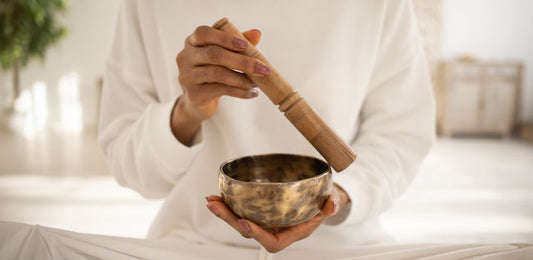
Singing bowl meditation is a calming practice where you play a metal or crystal bowl and rest your attention on its long, ringing tone. The point isn't the bowl itself. It's that a slow, predictable sound gives your mind something gentle to settle on, which helps the body move out of stress mode and into rest. It sits in the same family as breath meditation and restorative yoga.
Stress, in plain terms, is your body's fight-or-flight system staying switched on longer than it should. Your heart runs a little fast, your breathing goes shallow, your shoulders creep up toward your ears. The singing bowl practice works against that in a low-effort way. When you strike the bowl and listen to the tone fade all the way out, your breath naturally lengthens to match it. Longer, slower exhales are one of the most reliable everyday signals for the parasympathetic nervous system, the 'rest and digest' branch that calms you down.
That shift toward calm is what people mean by the relaxation response, a term coined by Harvard's Dr. Herbert Benson for the measurable state of lowered arousal you can bring on with meditation, slow breathing, or repeated sound. The bowl is just a friendly anchor. You could get there with breath alone, but the tone makes it easier because you have something clear to follow. For a fuller look at the mechanism and the instruments involved, our guide to sound healing covers how vibration and relaxation fit together.
Why sound makes calming down easier
A sustained tone gives your attention a soft place to land, which is exactly what an anxious, looping mind struggles to find on its own. Instead of fighting your thoughts, you rest on the sound and let it fade. That single, simple task is what makes bowl meditation feel more doable than sitting in silence for many beginners.
Most people who try to 'just meditate' hit the same wall. You sit down, close your eyes, and within seconds your mind is off making tomorrow's to-do list. There's nothing wrong with you. Silence gives a restless mind too much room. A singing bowl fills that room with one clear thing to follow, and following the tone until it disappears is a naturally absorbing task. You're not straining to empty your mind. You're just listening.
There's also a rhythm to it that matches how relaxation actually happens. Strike, listen, breathe, strike again. Each cycle is a small reset. Over ten minutes those resets add up, and the running commentary in your head gets quieter without you forcing it. This is why beginners often find the Tibetan singing bowl meditation approach an easier entry point than seated silent meditation. The bowl does some of the work of holding your focus for you.
None of this requires belief in energy or frequencies. You don't have to think the bowl is 'retuning your cells' for it to help. The honest, boring explanation is enough. You stop, you get quiet, you breathe slower, and your body takes the hint.
A practical daily practice for stress relief
A daily singing bowl practice for stress should be short, fixed, and forgiving. Aim for five to ten minutes at the same time each day, treat a wandering mind as normal, and value showing up over doing it perfectly. Regularity is what trains your nervous system to associate the bowl with letting go.
Here's a simple daily routine you can run in under ten minutes:
1. Pick a fixed time. First thing in the morning, or the moment you get home from work, both work well. A fixed anchor makes it a habit instead of a decision you have to make each day. 2. Settle your body. Sit comfortably with your back tall, or lie down if you prefer. Rest the bowl on your flat palm or on a cushion in front of you. 3. Strike once and just listen. Tap the rim gently with the mallet and follow the tone all the way until it fully fades to silence. Don't rush the next strike. 4. Breathe with the tone. Let each strike begin a slow inhale, and let the long decay of the sound carry an even slower exhale. The fading tone is your timer. 5. Repeat for five to ten minutes. Five or six strikes with full breaths between them is plenty. If your mind wanders, that's fine. Just come back to the next tone. 6. Close in silence. After your last strike, sit for a few breaths in the quiet. That pause, when you notice the calm, is the most valuable part.
Keep your expectations realistic. Some days you'll feel a clear drop in tension. Other days you'll just feel like you sat quietly for ten minutes, and that's still a win. The benefit builds across weeks of showing up, not in any single dramatic session. If part of your stress is a racing mind at night, a version of this done in bed can help you wind down. Our guide to using a singing bowl for sleep walks through an evening routine.
Building a weekly rhythm around your practice
A weekly rhythm gives your daily practice a backbone and a few longer sessions to look forward to. The idea is simple. Short calming sessions on most days, plus one or two slightly longer, more intentional sits per week, so the practice deepens without becoming a chore you dread.
Think of it in two layers. The daily layer is your five to ten minute reset, the non-negotiable habit that keeps stress from stacking up. The weekly layer is where you stretch out. Once or twice a week, set aside twenty to thirty minutes for a longer session. Dim the lights, add a few rounds of the continuous rim tone where you circle the mallet steadily around the outside of the bowl, and let yourself really sink in. Sunday evening is a favourite for many people, a way to reset before the week starts.
You can also pair the bowl with things you already do. A few strikes before your yoga or stretching practice helps mark the start and settle your focus, which is why many practitioners keep a bowl on the mat. Our piece on the singing bowl for yoga covers that pairing in more detail. A single strike before a meal, before you open your laptop, or before a difficult conversation works as a quick nervous-system cue too. These micro-moments don't count as meditation exactly, but they keep the calm accessible through a busy day.
Over a month, a workable rhythm looks like this. Five to seven short daily sits, one or two longer weekly sessions, and a handful of single-strike resets scattered wherever you need them. Miss a day, or a week, and nothing is lost. You just pick the bowl back up. The practice is patient even when life isn't.
How to build a simple home ritual
A good home ritual removes friction so you'll actually do it. Give the practice a fixed spot, a fixed time, and a bowl that's always within reach, and you turn a nice idea into a daily habit. The ritual around the practice matters as much as the practice itself, because it's what makes calming down feel automatic.
Start with a corner. It doesn't need to be a dedicated meditation room. A cushion by a window, a cleared shelf, a quiet spot on the floor, any of these can become 'the place I sit with my bowl.' Keep the bowl and mallet there in the open, not tucked away in a cupboard. A bowl you can see is a bowl you'll use. You might add a small cloth or ring cushion for the bowl to rest on, and maybe a candle or an incense stick if lighting one helps you shift gears.
On choosing a bowl, in plain Indian terms. A decent beginner Tibetan (metal) singing bowl usually sits around ₹1,500-3,000, and that's genuinely all most people need. Very cheap bowls under ₹800 tend to sound thin and fade fast, which defeats the whole purpose since the long decay is what you follow. Crystal bowls and multi-bowl sets climb past ₹5,000 and beyond, and they're lovely, but they're not required to start. For a first bowl, hold the tone in the shop or the video if you can, and pick the one whose ring lasts longest and feels warmest to you. If you want to understand how different bowls produce different notes, our singing bowl frequencies chart lays out the tones.
There's a familiar Indian logic to all of this. If you grew up around aarti, temple bells, and the hum of Om at home, you already know how a single sound can change the mood of a room. A singing bowl ritual is a portable, personal version of that. Many families in India also bring a bowl into the home around a housewarming (griha pravesh) or Diwali cleaning, using its clear tone to mark a fresh, calm start in a space. Frame it however feels true to you, as tradition, as self-care, or just as ten quiet minutes that are yours.
The honest evidence on singing bowls and stress
The evidence that singing bowl meditation lowers stress is genuine but early and limited. Small studies suggest people feel calmer and less tense after a session, and the broader science on meditation and relaxation for stress is stronger. But the specific research on bowls is preliminary, so it's fair to say bowls reliably help people relax, not that they treat any condition.
The study people cite most is Goldsby et al. 2017, published in the Journal of Evidence-Based Complementary & Alternative Medicine. In it, 62 people took part in a singing bowl sound meditation and reported significantly less tension, anger, fatigue, and depressed mood afterward, along with a greater sense of spiritual well-being. That's a real, encouraging result. It's also important to be honest about its limits. The study had no control group, so we can't cleanly separate the bowls from the simple act of lying down quietly for an hour. The sample was small, and people knew what they were there for. It points in a hopeful direction rather than proving cause and effect.
The stronger ground is the wider research on meditation and relaxation. The US National Center for Complementary and Integrative Health (NCCIH), part of the NIH, notes that meditation and mindfulness practices can help reduce stress and may ease anxiety, while also being clear that much of the research is still limited and that these practices are generally used alongside, not instead of, conventional care. Singing bowl meditation is one on-ramp to that same relaxation state. The bowl is a tool for slowing your breath and settling your attention, which is the part the broader evidence supports.
So here's the grounded takeaway. If you find bowl meditation relaxing and it helps you manage a stressful week, that's a real and worthwhile benefit, and it lines up with what we know about relaxation practices. Just steer clear of the bigger claims, the ones about specific frequencies curing illness or vibration 'detoxing' your body. Those aren't supported. For a level-headed look at the mental and emotional side specifically, our guide to singing bowl benefits for the mind stays on the same honest footing.
Frequently Asked Questions
How does singing bowl meditation help with stress?
It gives your nervous system a simple cue to slow down. When you follow a bowl's long fading tone with your breath, your exhales naturally lengthen, which helps switch on the parasympathetic 'rest and digest' response, sometimes called the relaxation response. The steady sound also gives a busy mind something easy to rest on, so you settle without straining.
How long should I meditate with a singing bowl each day?
Five to ten minutes most days is enough to feel a difference over time. Consistency matters far more than length. A short daily sit at a fixed time trains your body to associate the bowl with letting go, and that regular habit does more for everyday stress than an occasional long session.
Do I need any experience or special training to start?
No. Singing bowl meditation is beginner-friendly by design. You strike the bowl, listen until the tone fades, breathe slowly, and repeat. There's no technique to master and no wrong way to feel. A wandering mind is completely normal, and simply returning your attention to the next tone is the whole practice.
Is there real scientific evidence that singing bowls reduce stress?
The evidence is genuine but early. The most-cited study, Goldsby et al. 2017 with 62 people, found less tension, anger, fatigue, and anxiety after a session, but it had no control group, so it stays preliminary. The broader research on meditation and relaxation for stress, summarised by the NIH's NCCIH, is stronger. It's fair to say bowls reliably help people relax, not that they cure anything.
What kind of singing bowl should a beginner buy in India?
For most people, one good mid-range Tibetan (metal) bowl is ideal, usually around ₹1,500-3,000. Avoid very cheap bowls under ₹800, which tend to sound thin and fade fast, since the long decay is what you follow. Crystal bowls and full sets cost more but aren't necessary to begin. Pick the bowl whose tone rings longest and feels warmest to you.
Can singing bowl meditation replace therapy or medication for anxiety?
No. It's a complementary relaxation practice, not a treatment. It may help you feel calmer and manage stress, which is genuinely valuable, but it does not cure anxiety, depression, or any condition. If you're dealing with chronic stress or a mental-health concern, keep working with your doctor or therapist and use the bowl as a supportive extra.
When is the best time of day to practise?
Whenever you'll actually do it consistently. First thing in the morning sets a calm tone for the day, while an evening session helps you unwind and can ease you toward sleep. The best time is a fixed one you can repeat, because a predictable anchor is what turns the practice into a lasting habit.
Sources
- Goldsby TL, Goldsby ME, McWalters M, Mills PJ. Effects of Singing Bowl Sound Meditation on Mood, Tension, and Well-being: An Observational Study. Journal of Evidence-Based Complementary & Alternative Medicine, 2017: https://pmc.ncbi.nlm.nih.gov/articles/PMC5871151/
- PubMed record for the Goldsby et al. singing bowl study (PMID 27694559): https://pubmed.ncbi.nlm.nih.gov/27694559/
- National Center for Complementary and Integrative Health (NIH) - Meditation and Mindfulness: What You Need To Know: https://www.nccih.nih.gov/health/meditation-and-mindfulness-what-you-need-to-know
About the author