Sunstone and Moonstone: A Complete Pairing Guide for Confidence and Calm Intuition


Sunstone and moonstone is the most symbolically tidy pairing in crystal practice — two feldspars from the same mineral family, one tied to the sun and one to the moon, used together as a "day and night" combination. The symbolism isn't a marketing invention; it traces back to Pliny the Elder in the first century CE, and resurfaced in Roman silverwork, medieval lapidaries, and the Art Nouveau jewelry of René Lalique. This guide covers the mineralogy, the symbolic logic of the pairing, and how to wear and care for the combination as a beaded bracelet — including the unusual fact that, of all popular crystal pairings, this one has zero hardness gap.
- Sunstone is a plagioclase feldspar (oligoclase or labradorite variety), Mohs 6-6.5, with copper-flash inclusions known as aventurescence (GIA).
- Moonstone is an orthoclase feldspar ((Na,K)AlSi₃O₈), Mohs 6-6.5, with the pearly blue-white sheen known as adularescence — produced by light interference at thin orthoclase/albite layers (GIA).
- Identical hardness — neither stone scratches the other, a rare advantage among crystal pairings.
- Energetic logic: sunstone at solar plexus (confidence, action) and moonstone at crown or third eye (intuition, emotional calm). Lower-and-upper chakra coverage in a single pair.
- Notable origins: Lake County, Oregon (Oregon sunstone, state gemstone since 1987) and Meetiyagoda, Sri Lanka (the world's only commercial source of fine blue moonstone).
- Both stones have perfect or near-perfect cleavage — beads handle this fine, but neither stone is suited to daily-wear ring settings.

Why Pair Sunstone and Moonstone?
The pairing works on three levels at once: mineralogical, symbolic, and chakra-based. Mineralogically, both stones are feldspars — the most abundant mineral group in the Earth's crust — so they share crystal structure characteristics, near-identical hardness, and similar polish. Symbolically, the sun-and-moon framing is one of the oldest in human culture. Pliny the Elder, writing in the first century CE, described moonstone as a stone whose inner image changed with the phases of the moon. The Romans set moonstone in silver (the "lunar" metal) and sunstone-like aventurescent feldspars in gold, an association that persisted through medieval European lapidary traditions.
In the modern Western chakra system, sunstone sits at the solar plexus chakra (manipura), associated with personal power, confidence, and action. Moonstone sits at the crown chakra (sahasrara) for spiritual awareness, or at the third eye (ajna) for intuition. The pairing covers a lower and an upper chakra in a single set, which is part of why it shows up so often in beginner crystal kits. From what we've seen, customers tend to choose this pair when they're navigating a transition — a new role, a creative shift, a recovery period — where they need both forward motion and quiet self-awareness.
Sunstone Mineralogy
Sunstone is a plagioclase feldspar — most often a variety of oligoclase, or, in the case of Oregon sunstone, labradorite. The shimmer that gives the stone its name comes from microscopic plate-like inclusions of copper or hematite that scatter light as the stone rotates. The Gemological Institute of America calls this optical effect aventurescence (GIA). On the Mohs scale, sunstone sits at 6-6.5, slightly below quartz at 7. Like all plagioclase feldspars, it has two perfect cleavage directions, which is why most sunstone is set in pendants, earrings, and bracelets rather than in daily-wear rings.
The most famous US source is the basalt flows of Lake County and Harney County, Oregon, near the small town of Plush. Oregon designated Oregon sunstone its state gemstone on 4 August 1987 by joint resolution (Oregon Encyclopedia). Other commercial sources include India, Tanzania, Norway, Madagascar, and Russia.
Moonstone Mineralogy
Moonstone is an orthoclase feldspar with the formula (Na,K)AlSi₃O₈ — a sodium-potassium aluminum silicate. Most commercial moonstone is roughly 70% orthoclase and 30% albite (Geology.com). Its signature billowy blue-white sheen, called adularescence, comes from light interference at thin alternating layers of those two minerals — a structure that develops as the feldspar cools below roughly 600°C and the originally homogeneous crystal separates into potassium-rich and sodium-rich bands. When those bands are thin enough to match the wavelength of visible light, you get the floating glow that makes the stone distinctive.
Moonstone is Mohs 6-6.5, with two cleavage directions — one of them perfect. The most prominent commercial source is the village of Meetiyagoda in southwest Sri Lanka, sitting above what's reported as the world's largest vein of moonstone-bearing pegmatite, and the only place on Earth that produces fine blue moonstone (Wikipedia). Other major sources include India (Orissa, Jharkhand), Madagascar, Myanmar, Brazil, Norway, Australia, and the United States. Sri Lankan blue moonstone trades at a meaningful premium over common white or rainbow moonstone.
Historically, the stone has shown up in waves. Pliny the Elder described it in Naturalis Historia, and Romans associated it with the lunar goddesses Diana and Luna. It saw a major resurgence during the Art Nouveau period (roughly 1890-1910) in the work of René Lalique and Louis Comfort Tiffany, who valued its soft, organic glow for fluid, nature-inspired designs.
Wearability: A Rare Zero Hardness Gap
The most practically useful detail about this pairing is that both stones share the same Mohs hardness, 6-6.5. That means neither stone will scratch the other in a stacked bracelet — a rare advantage. Most popular crystal pairings have at least a half-point gap (sunstone-sodalite, amethyst-rose-quartz, jasper-aventurine), and some have a full point or more (amethyst-sodalite, quartz-lepidolite). For sunstone-moonstone, you can mix beads of identical size and the polish stays even.
The real wearability concern is cleavage. Both stones are feldspars with perfect or near-perfect cleavage in two directions, which means a sharp impact can split a bead along a cleavage plane rather than just chip the surface. As beads, this isn't a major risk in normal handling. As ring centerstones exposed to constant impact, it's a real concern, which is why most moonstone and sunstone ends up in pendants, earrings, and bracelets rather than rings.
| Property | Sunstone | Moonstone |
|---|---|---|
| Mineral group | Plagioclase feldspar (oligoclase / labradorite) | Orthoclase feldspar (potassium feldspar) |
| Formula | (Na,Ca)(Al,Si)AlSi₂O₈ | (Na,K)AlSi₃O₈ |
| Mohs hardness | 6-6.5 | 6-6.5 |
| Cleavage | Two directions (perfect) | Two directions, one perfect |
| Crystal system | Triclinic | Monoclinic |
| Color | Gold to red-orange with copper flash | White to blue with pearly sheen |
| Optical effect | Aventurescence (metallic flash) | Adularescence (billowy glow) |
| Best jewelry formats | All except rings | All except rings |
How to Use the Pairing
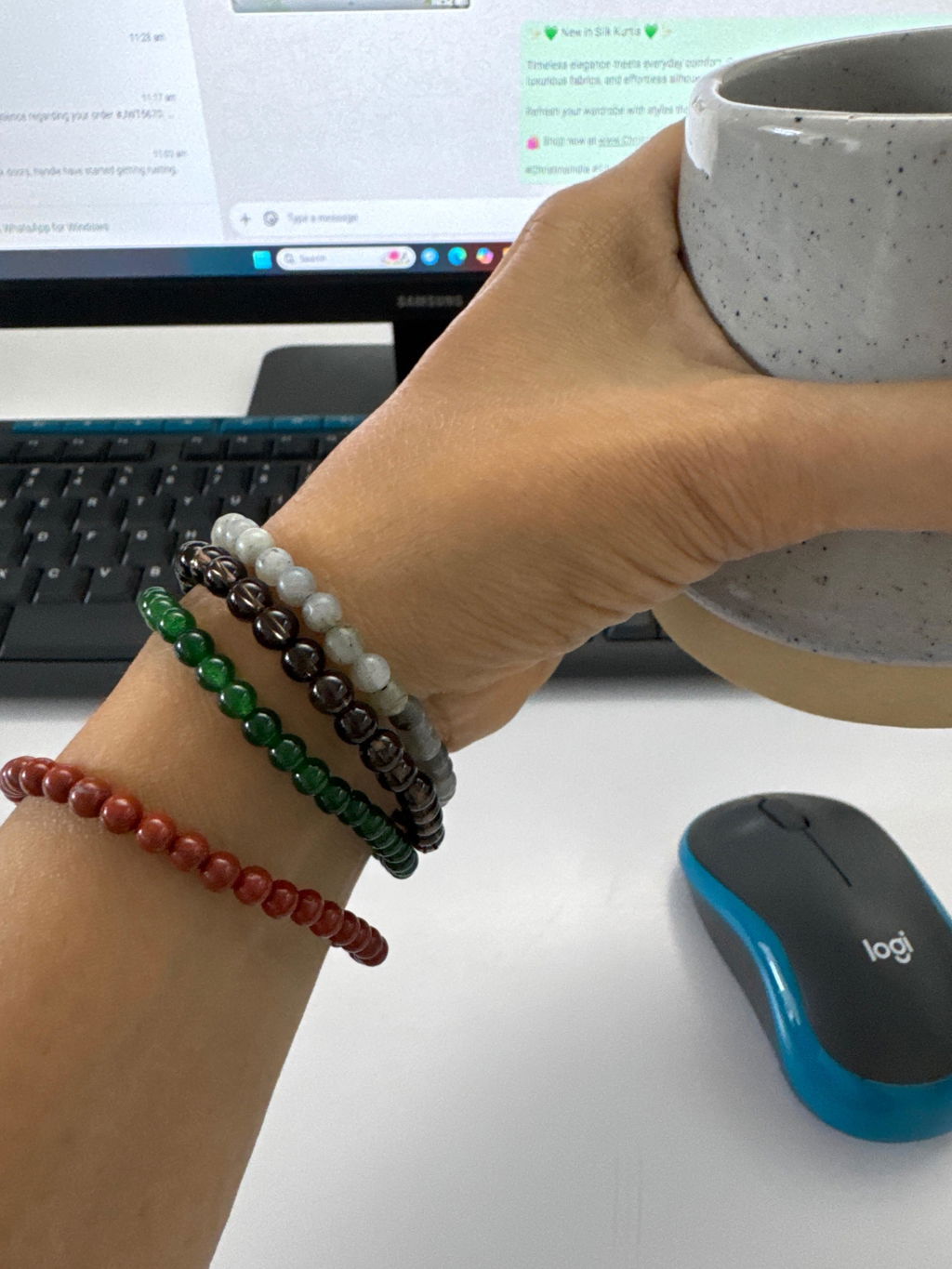
Beaded bracelet stack. The most common format. Alternating sunstone and moonstone beads in 6mm or 8mm sizing creates a striking warm-and-cool contrast, and the matched hardness means the polish stays even on both stones over time. This is the format we sell most often at Solacely for this pair.
Pendant pair. A sunstone pendant alongside a moonstone cabochon pendant on separate chains. Pendants take less impact than bracelets, so this is the safest format for the moonstone, where cleavage is the main durability concern.
Meditation set. Hold sunstone in the dominant hand for clarity of action and forward focus; hold moonstone in the non-dominant hand for receptivity and inner listening. Many practitioners use this pair specifically for new-moon and full-moon journaling — the symbolism gives the practice a clear visual anchor.
Workspace placement. Set sunstone near the part of your workspace tied to action — your keyboard, your phone, your sketchpad. Set moonstone near the part tied to reflection — your reading chair, your journal, your bedside table. The visual contrast is part of the cue.
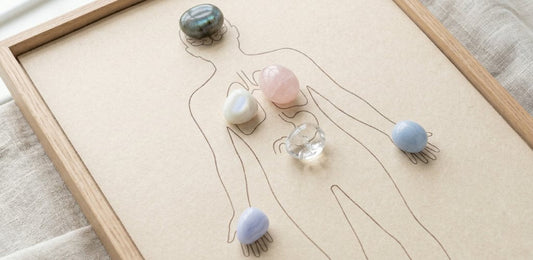
Chakra layout. For a lying-down meditation, place sunstone on the solar plexus (the soft area below the sternum) and moonstone at the crown of the head, or at the third eye just above the brow line. The two locations correspond to the chakras each stone is traditionally associated with.
How to Care for the Combination
Both stones have the same hardness, but both have feldspar cleavage. Care for the pair at the gentler standard set by moonstone, which is the more impact-sensitive of the two.
Cleaning. Warm soapy water with a soft cloth handles both stones safely. Skip ultrasonic and steam cleaners — vibration and heat can propagate fractures along feldspar cleavage planes, and moonstone is particularly vulnerable. Avoid harsh chemicals and acetone-based jewelry dips.
Storage. Store the two stones separately in soft pouches. Although the matched hardness means they won't scratch each other, sharp bead-on-bead contact in a shared pouch can cause cleavage chipping. Both stones tolerate normal indoor lighting; avoid prolonged direct sunlight, which can fade some moonstone over years (GIA).
Energetic cleansing. Selenite plate overnight is the safest method for both stones — passive, no rituals, no risk of damage. Smoke (sage, palo santo from sustainable sources) and sound (singing bowls, tuning forks) also work for both. A 30-second rinse under cool running water is fine; dry both stones thoroughly with a soft cloth right away, particularly the moonstone, where prolonged moisture against natural fissures can dull the surface over years.
Frequently Asked Questions
What does the sunstone and moonstone combination do?
Sunstone (solar plexus chakra, confidence and vitality) and moonstone (crown chakra, intuition and emotional calm) are paired most often as a "day and night" combination. Sunstone is associated with action, warmth, and personal power; moonstone with reflection, receptivity, and inner balance. Together they support situations that call for both decisive forward motion and quiet self-awareness.
Can you wear sunstone and moonstone as a bracelet?
Yes. Both stones share the same Mohs hardness of 6-6.5, so neither will scratch the other in a stacked bracelet — a rare advantage among popular pairings. The practical concern is moonstone's perfect cleavage; a sharp impact can split rather than just chip the bead. Treat the bracelet as an intentional piece, remove it for hands-on work, and clean gently.
What chakra does moonstone work with?
In the modern Western chakra system, moonstone is most often placed at the crown chakra (sahasrara) for spiritual awareness, or at the third eye chakra (ajna) for intuition. The pearly white-and-blue adularescent sheen is the visual marker that links it to the upper chakras in the seven-color rainbow framework. Some practitioners also use it at the sacral chakra for emotional balance.
Where does moonstone come from?
The most prominent source is Sri Lanka, particularly the village of Meetiyagoda in the country's southwest, which produces the world's finest blue moonstone. Other major commercial sources include India (Orissa and Jharkhand), Madagascar, Myanmar, Brazil, Norway, Australia, and the United States. Sri Lankan blue moonstone commands a significant premium over common rainbow or white moonstone.
How do you care for sunstone and moonstone jewelry?
Use warm soapy water with a soft cloth on both stones. Skip ultrasonic and steam cleaners — both can damage feldspar cleavage planes, and moonstone is particularly vulnerable. Avoid harsh chemicals and prolonged direct sunlight. Store in soft pouches; even though the two stones share the same hardness, contact between beads can cause cleavage chipping. Moonlight charging is ideal for moonstone; brief morning sun is fine for sunstone.
About the author